

In 2026, a clear goal carries more motivation than a fat folder — the ValidVCE PEGACLSA_62V2 materials are built so you can choose exactly what fits your own needs, from printable PDF to timed engine to the online version.
Pegasystems PEGACLSA_62V2 Exam Overview:
| Certification Vendor: | Pegasystems |
|---|---|
| Exam Name: | Certified Lead System Architect (CLSA) 6.2V2 |
| Exam Number: | PEGACLSA_62V2 |
| Available Languages: | English |
| Passing Score: | 70% |
| Exam Price: | $1750 USD |
| Certificate Validity Period: | Certification version aligned to Pega 6.2; remains valid for the certified version |
| Exam Duration: | 480 minutes |
| Related Certifications: | Pega Certified System Architect (CSA) Pega Certified Senior System Architect (CSSA) |
| Real Exam Qty: | Architecture Application Build Exam and Architecture Design Exam |
| Exam Format: | Architecture Design Exam, Scenario-Based Assessment, Practical Application Build Exam |
| Sample Questions: |  |
| Exam Way: | Delivered as a multi-part certification process consisting of an Architecture Application Build Exam and an Architecture Design Exam, completed through Pega Academy's certification program. |
| Pre Condition: | Must hold the Pega Certified Senior System Architect (CSSA) certification and complete the CLSA readiness requirements before attempting the CLSA certification process. |
| Official Syllabus URL: | https://academy.pega.com/certifications/lead-system-architect |
Pegasystems PEGACLSA_62V2 Exam Syllabus Topics:
| Section | Objectives |
|---|---|
| Enterprise Application Architecture | - Architectural Planning
|
| Integration Architecture | - Enterprise Connectivity
|
| Leadership and Solution Design | - Lead Architect Responsibilities
|
| Data Architecture | - Data Modeling
|
| Business Process Design | - Process Architecture
|
| Performance and Scalability | - System Optimization
|
| Deployment and Governance | - Application Lifecycle Management
|
| Security and Access Control | - Application Security
|
Preparing for PEGACLSA_62V2 Without Wasting Money
- Integration Architecture ()
- Business Process Design ()
- Performance and Scalability ()
Pegasystems Certified Lead System Architect (CLSA) 6.2V2 Sample Questions:
In the August 20-24, 2012 period, the operators "Architect2" and "Architect4" create the following number of work items: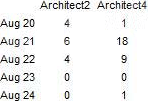
An architect wishes to create a report that charts this data as follows: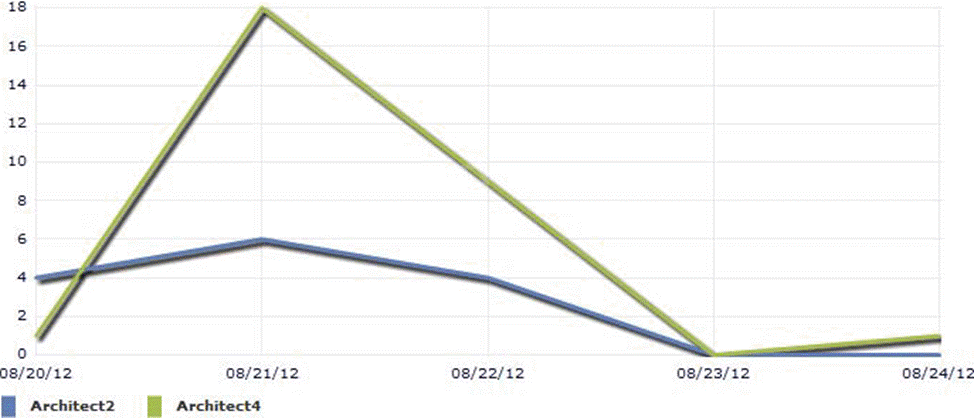
What is the simplest way to create a report with this chart? (Choose One)
- A. Create a Report Definition, grouped by Operator and Creation Date/Time, pivoted by Operator
- B. Create a List View Report
- C. Create a Report Definition Report, without grouping
- D. Create a Report Definition, grouped by Operator and Creation Date/Time
- E. Create a Summary View Report
Correct Answer: E 🗳️
Which of the following statements is most accurate about the Split-For-Each and Split-Join shapes? (Choose One)
- A. Split-For-Each allows you to execute different sub-flows whereas Split-Join calls the same process on different pages
- B. Split-For-Each can only be used when iterating over a list of work objects
- C. Split-Join allows you to execute different sub-flows whereas Split-For-Each calls the same process on different pages
- D. Both shapes create separate Threads for sub-processes they create
Correct Answer: C 🗳️
Using multiple roles on a single Access Group can be useful for which of the following reason? (Choose One)
- A. It is the best way to conditionally grant access
- B. It eliminates the need for privilege
- C. It is the only way to create managers who also do work
- D. It can improve reuse and eliminate dual maintenance of role definitions
- E. It improves run-time performance by reducing the number of caches
Correct Answer: D 🗳️
MyCo uses PRPC application to process claims. One of the user groups involved in the process should be able to perform assignments on any piece of "urgent" work no matter who it is assigned to using the "get most urgent" functionality.
Which of the following approaches would you most likely take to ensure that workers from that user group would perform any "urgent" work no matter who it is assigned to? (Choose One)
- A. Attribute the highest skills level to the workers in that user group
- B. Circumstance the standard List view rule used by "Get Most Urgent" to pull work from workers' worklist based on user's workgroup. Update the circumstanced version to not check the assigned operator
- C. Create a special Role for the workers in that user group. Update the standard activity supporting the "Get most urgent" functionality to bypass any security measure if the user has that special role
- D. Create a special privilege rule to the workers in that user group. Make sure only workers from that group have been attributed the privilege
Correct Answer: B 🗳️
Which of the following statements are NOT accurate regarding the "Goal Seek" functionality? (Choose Two)
- A. Goal seek is a general pattern with sample rules provided by PRPC. However, it is expected that these rules will be customized for your application's needs
- B. Goal seek is a PRPC feature that uses a landing page to control its configuration
- C. Goal seek can be configured to use both direct user input and data retrieved from external sources when calculating a value
- D. Goal seek can be useful in presenting a user a complete list of questions they must answer as part of a survey
- E. Goal seek utilizes backward chaining to determine which properties are needed to a complete a calculation
Correct Answer: B,D 🗳️
Viewing page 1 out of 30 pages.
Viewing questions 1-5 out of 150 questions.


 1458 Customer Reviews


