

ISO-IEC-27001-Lead-Auditor-CN Revolutionary Guide To Exam PECB Dumps
ISO-IEC-27001-Lead-Auditor-CN Free Study Guide! with New Update 418 Exam Questions
NEW QUESTION # 97
場景 7:Lawsy 是一家領先的律師事務所,在新澤西州和紐約市設有辦公室。它擁有 50 多名律師,為商業法、智慧財產權、銀行和金融服務領域的客戶提供完善的法律服務。他們相信,由於他們致力於實施資訊安全最佳實踐並跟上技術發展的步伐,他們在市場上佔據了有利的地位。
Lawsy 已經嚴格實施、評估和進行 ISMS 內部審核兩年了。
現在,他們已向知名且值得信賴的認證機構ISMA申請ISO/IEC 27001認證。
在第一階段審核期間,審核小組審查了實施過程中所建立的所有 ISMS 文件。
他們還審查和評估了管理審查和內部審計的記錄。
Lawsy 提交了證據記錄,表明在必要時對不合格項採取了糾正措施,因此審核組約談了內部審核員。訪談透過提供對內部稽核計畫和程序的詳細了解,驗證了內部稽核的充分性和頻率。
審計小組繼續驗證戰略文件,包括資訊安全政策和風險評估標準。在資訊安全政策審查期間,團隊注意到描述治理框架(即資訊安全政策)的記錄資訊與程序之間存在不一致。
儘管允許員工將筆記型電腦帶到工作場所之外,但 Lawsy 並沒有製定有關在這種情況下使用筆記型電腦的程序。此政策僅提供有關筆記型電腦使用的一般資訊。該公司依靠員工的常識來保護筆記型電腦中儲存的資訊的機密性和完整性。該問題已記錄在第一階段審計報告中。
完成第一階段審核後,審核組長準備了審核計劃,其中規定了審核目標、範圍、標準和程序。
在第二階段審核期間,審核小組約談了資安經理,資安經理起草了資訊安全政策。他透過指出 Lawsy 每三個月舉辦一次強制性資訊安全培訓和意識課程來證明第一階段中確定的問題的合理性。
面談後,審核小組檢查了 15 份員工培訓記錄(共 50 份),得出的結論是 Lawsy 符合 ISO/IEC 27001 有關培訓和意識的要求。為了支持這個結論,他們影印了檢查過的員工訓練記錄。
根據上述場景,回答以下問題:
Lawsy 缺乏關於在工作場所之外使用筆記型電腦的程序,它依賴員工的常識來保護筆記型電腦中儲存的資訊的機密性。這提出:
- A. 不合格項
- B. 異常
- C. 一致性
Answer: A
Explanation:
Lawsy's lack of specific procedures for the use of laptops outside the workplace, despite allowing such use, represents a nonconformity. ISO/IEC 27001 requires that security controls and management processes be clearly defined, documented, and implemented. Relying solely on employees' common knowledge does not fulfill the standard's requirements for managing information security risks associated with mobile and teleworking.
NEW QUESTION # 98
您是 ISMS 審核員,正在對電信供應商進行第三方監督審核。您位於設備暫存室,網路交換器在傳送給客戶之前已預先編程。您注意到,最近未通過初始設定測試並被退回重新編程的交換器數量顯著增加。
你問首席測試員為什麼,她說,「這是最近 ISMS 升級的結果」。在升級之前,每個技術人員都有自己的硬拷貝工作說明。現在,我團隊的八名成員必須共用兩台筆記型電腦才能在線上存取客戶的設定說明。這些延誤給技術人員帶來了壓力,導致更多錯誤。
僅根據上述訊息,ISO/IEC 27001:2022 的哪一條條款最適合提出不合格項?選擇一個。
- A. 第 10.2 條 - 不合格與糾正措施
- B. 第 7.2 條 - 能力
- C. 第 7.5 條 - 記錄資訊
- D. 第 8.1 條 - 營運規劃與控制
Answer: D
NEW QUESTION # 99
情境 6
Sinvestment是一家提供多種保險方案的保險公司,包括房屋保險、商業保險和人壽保險。該公司最初成立於北加州,現已將業務拓展至歐洲和非洲等其他地區。除了業務成長之外,Sinvestment還致力於遵守其所在行業的相關法律法規,並防止任何資訊安全事件的發生。他們已實施基於ISO標準的資訊安全管理系統(ISMS)。
/IEC 27001,並已申請認證。
認證機構指派了一支審核團隊進行審核。審核團隊與Sinvestment簽署保密協議後,便開始了審核工作。第一階段審核的所有活動均在現場進行,但應Sinvestment的要求,對已存檔資訊的審查工作將以遠端方式進行。
審計團隊首先進行了第一階段審計,審查了所需文件,包括資訊安全管理系統(ISMS)範圍聲明、資訊安全策略和內部審計報告。已記錄資訊的評估主要基於其內容和管理流程。
此外,審計人員還發現,與資訊安全培訓和意識提升專案相關的文件不完整,缺乏關鍵細節。當被問及此事時,Sinvestment 的高階管理人員表示,該公司已為所有員工提供了資訊安全培訓課程。
第二階段審計在第一階段審計三週後進行。審計小組發現,行銷部(未包含在審計範圍內)沒有控制員工存取權限的程序。
由於控制員工存取權限是 ISO/IEC 27001 的要求之一,並且已納入公司的資訊安全政策,因此該問題被納入了審計報告。
問題
根據情境 6,審計團隊是否應該將市場部門存取權限控製程序中發現的缺陷納入審計報告?
- A. 不,因為市場部門的活動不會對資訊安全管理系統構成潛在風險。
- B. 是的,審計報告必須包含所有審計結果。
- C. 不,應該只告知被審計單位的代表。
Answer: B
Explanation:
It was appropriate for the audit team to include the observed deficiency in the audit report, making option A the correct answer. ISO/IEC 17021-1 and ISO 19011 require auditors to report all relevant findings that relate to conformity with the audit criteria, regardless of whether the affected department is formally listed within the audit scope. What matters is whether the issue relates to ISMS requirements or policies.
In this scenario, access rights control is explicitly included in Sinvestment's information security policy and is a core requirement of ISO/IEC 27001. The absence of access control procedures in the marketing department represents a weakness in the implementation of an ISMS requirement. Even though the marketing department was not part of the defined audit scope, the auditors became aware of a condition that could negatively affect the effectiveness of the ISMS as a whole.
Option B is incorrect because merely communicating the issue informally would undermine transparency and traceability. Audit reports must provide a complete and accurate record of findings. Option C is incorrect because marketing departments frequently handle personal data and sensitive information, particularly in an insurance context, and therefore clearly pose potential ISMS risks.
Auditors are required to report relevant findings objectively and without omission. Therefore, inclusion of the issue in the audit report was appropriate.
NEW QUESTION # 100
a------------ 的職責包括促進審核活動、維護後勤、確保遵守健康和安全政策以及代表受審核方見證審核過程。
- A. 內部稽核員
- B. 觀察者
- C. 指南
Answer: C
Explanation:
The responsibilities described fit those of a "guide." A guide in an audit context is typically someone from the auditee's organization who facilitates audit activities, manages logistics, ensures compliance with health and safety policies, and may also witness the audit process, assisting the audit team.
References: ISO 19011:2018, Guidelines for auditing management systems
NEW QUESTION # 101
以下是保護您的密碼的準則,但以下情況除外:
- A. 不同公司係統安全存取不要使用相同的密碼
- B. 為了方便回憶,公司和個人帳號使用相同的密碼
- C. 不要與任何人分享密碼
- D. 首次登入時變更暫時密碼
Answer: B,C
Explanation:
The following are guidelines to protect your password, except for easy recall use the same password for company and personal accounts; do not share passwords with anyone. Using the same password for company and personal accounts is not a guideline to protect your password, as it increases the risk of compromising your password if one of your accounts is hacked or breached. You should use different and unique passwords for each account, and change them regularly. Sharing passwords with anyone is not a guideline to protect your password, as it reduces the security and accountability of your password. You should keep your password confidential and never disclose it to anyone, even if they claim to be authorized or trustworthy. Don't use the same password for various company system security access is a guideline to protect your password, as it prevents unauthorized access or misuse of your password if one of the systems is compromised or breached. You should use different and complex passwords for each system, and follow the password policies and standards of the organization. Change a temporary password on first log-on is a guideline to protect your password, as it prevents unauthorized access or misuse of your password if the temporary password is intercepted or leaked. You should change the temporary password to a personal and secure password as soon as possible, and avoid using default or predictable passwords. Reference: : CQI & IRCA ISO 27001:2022 Lead Auditor Course Handbook, page 43. : [ISO/IEC 27001 LEAD AUDITOR - PECB], page 15.
NEW QUESTION # 102
您正在一家名為 ABC 的提供醫療保健服務的住宅療養院進行 ISMS 審核。
審核計劃的下一步是驗證 ABC 醫療保健行動應用程式開發、支援和生命週期流程的資訊安全性。在審核過程中,您了解到該組織將行動應用程式開發外包給了一家具有 CMMI 5 級、ITSM(ISO
/IEC
20000-1)、BCMS (ISO 22301) 和 ISMS (ISO/IEC 27001) 認證。 IT經理介紹了軟體安全管理流程,並將流程總結如下:
行動應用程式開發至少應採用「設計安全」和「預設安全」原則。應具備以下個人資料保護安全功能:
存取控制。
個人資料加密,即高階加密標準(AES)演算法,金鑰長度:256位元;個人資料假名化。
已檢查漏洞,無安全後門
您可以獲得最新的行動應用測試報告樣本 - 詳細資訊如下: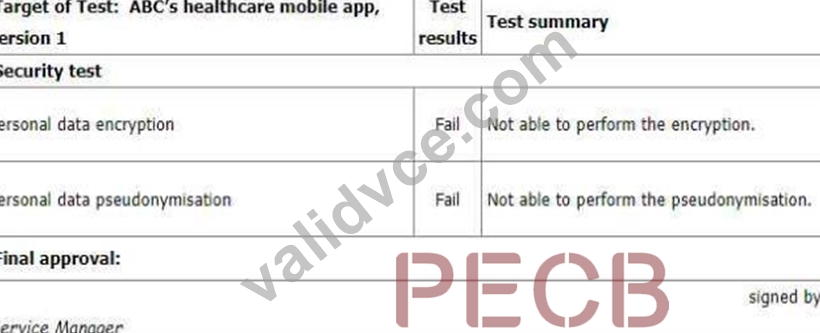
您詢問 IT 經理,為什麼組織仍在使用行動應用程序,而個人資料加密和假名化測試卻失敗了。此外,服務經理是否有權批准測試。
IT經理解釋說,根據軟體安全管理程序,測試結果應由他批准。加密和假名功能失敗的原因是這些功能嚴重降低了系統和服務效能。額外的
需要 150% 的資源來實現這一點。服務經理同意存取控制足夠好並且可以接受。這就是服務經理簽署批准書的原因。
您對醫務人員的手機進行採樣,發現 ABC 的醫療保健行動應用程式版本
1.01 已安裝。你發現1.01版本沒有測試記錄。
IT經理解釋說,由於勒索軟體攻擊頻繁,外包行動應用開發公司對受測軟體進行了免費小幅更新,並對更新後的軟體進行了緊急發布,並口頭保證不會對安全造成任何影響。以他20年的資訊安全經驗來看,沒有必要重新測試。
您正在準備審核結果 請選擇兩個正確的選項。
- A. 還有改進的機會 (OI)。 IT 經理應根據適當的測試做出是否繼續提供服務的決定。 (與第 8.1 條相關,控制措施 A.8.30)
- B. 不存在不合格項 (NC)。 IT 經理展現了良好的領導能力。 (與條款相關
5.1,控制5.4) - C. 還有改進的機會 (OI)。該組織根據其提供的免費服務的範圍選擇外部服務提供者。 (與第 8.1 條相關,控制措施 A.5.21)
- D. 存在不合格項 (NC)。組織不控制計劃的變更並審查非預期變更的後果。 (與第8.1條相關)
- E. 不存在不合格項 (NC)。 IT 經理證明他完全有能力。 (與第7.2條相關)
- F. 存在不合格項 (NC)。 IT。管理者不遵守軟體安全管理程序。 (與第 8.1 條相關,控制措施 A.8.30)
Answer: D,F
Explanation:
According to ISO/IEC 27001, organizations must control planned changes and review the consequences of unintended changes in order to ensure continued alignment with information security requirements. In this scenario, the organization failed to perform appropriate testing after an emergency update to the mobile app, which constitutes a nonconformity with clause 8.1 of the standard.
**References**:
- ISO/IEC 27001 Lead Auditor Reference Materials
- PECB Candidate Handbook for ISO 27001 Lead Auditor
ISO/IEC 27001 requires that organizations adhere to their established procedures for software security management. The IT Manager's approval of the app despite failed security tests and lack of proper documentation for the new version indicates noncompliance with the procedure, thus reflecting a nonconformity.
**References**:
- ISO/IEC 27001 Lead Auditor Reference Materials
- PECB Candidate Handbook for ISO 27001 Lead Auditor
NEW QUESTION # 103
當審核團隊的另一位成員向您尋求澄清時,您正在進行第三方監督審核。他們被要求評估組織對控制 5.7 - 威脅情報的應用。他們知道這是 2022 年版 ISO/IEC 中引入的新控制措施之一
27001,他們希望確保正確審核控制。
他們準備了一份清單來協助他們進行審核,並希望您確認他們計劃的活動符合控制要求。
下列哪三個選項代表有效的審計追蹤?
- A. 我將確保採取適當措施,向最高管理階層通報目前威脅情報安排的有效性
- B. 我將檢視組織的威脅情報流程,並確保對此進行完整記錄
- C. 我將確保將產生威脅情報的任務分配給組織的內部稽核團隊
- D. 我將確定在威脅情報的生成中是否使用內部和外部資訊來源
- E. 我將確保組織的風險評估流程從有效的威脅情報開始
- F. 我將檢查是否積極使用威脅情報來保護組織資訊資產的機密性、完整性和可用性
- G. 我將與高階主管交談,以確保所有員工都意識到報告威脅的重要性
- H. 我將回顧如何收集和評估與資訊安全威脅相關的資訊以產生威脅情報
Answer: B,D,F
Explanation:
According to ISO/IEC 27001:2022, which specifies the requirements for establishing, implementing, maintaining and continually improving an information security management system (ISMS), control 5.7 requires an organization to establish and maintain a threat intelligence process to identify and evaluate information security threats that are relevant to its ISMS scope and objectives1. The organization should use internal and external sources of information, such as vulnerability databases, threat feeds, industry reports, etc., to produce threat intelligence that can be used to support risk assessment and treatment, as well as other information security activities1. Therefore, when auditing the organization's application of control 5.7, an ISMS auditor should verify that these aspects are met in accordance with the audit criteria.
Three options that represent valid audit trails for verifying control 5.7 are:
* I will review the organisation's threat intelligence process and will ensure that this is fully documented:
This option is valid because it can provide evidence of how the organization has established and maintained a threat intelligence process that is consistent with its ISMS scope and objectives. It can also verify that the process is documented according to clause 7.5 of ISO/IEC 27001:20221.
* I will check that threat intelligence is actively used to protect the confidentiality, integrity and availability of the organisation's information assets: This option is valid because it can provide evidence of how the organization has used threat intelligence to support its risk assessment and treatment, as well as other information security activities, such as incident response, awareness, or monitoring. It can also verify that the organization has achieved its information security objectives according to clause 6.2 of ISO/IEC 27001:20221.
* I will determine whether internal and external sources of information are used in the production of threat intelligence: This option is valid because it can provide evidence of how the organization has used various sources of information, such as vulnerability databases, threat feeds, industry reports, etc., to produce threat intelligence that is relevant and reliable. It can also verify that the organization has complied with the requirement of control 5.7 of ISO/IEC 27001:20221.
The other options are not valid audit trails for verifying control 5.7, as they are not related to the control or its requirements. For example:
* I will speak to top management to make sure all staff are aware of the importance of reporting threats:
This option is not valid because it does not provide evidence of how the organization has established and maintained a threat intelligence process or used threat intelligence to support its ISMS activities. It may be related to another control or requirement regarding information security awareness or communication, but not specifically to control 5.7.
* I will ensure that the task of producing threat intelligence is assigned to the organisation s internal audit team: This option is not valid because it does not provide evidence of how the organization has established and maintained a threat intelligence process or used threat intelligence to support its ISMS activities. It may also contradict the requirement for auditor independence and objectivity, as recommended by ISO 19011:20182, which provides guidelines for auditing management systems.
* I will ensure that the organisation's risk assessment process begins with effective threat intelligence:
This option is not valid because it does not provide evidence of how the organization has established and maintained a threat intelligence process or used threat intelligence to support its ISMS activities. It may also imply a prescriptive approach to risk assessment that is not consistent with ISO/IEC 27005:
20183, which provides guidelines for information security risk management.
* I will review how information relating to information security threats is collected and evaluated to produce threat intelligence: This option is not valid because it does not provide evidence of how the organization has established and maintained a threat intelligence process or used threat intelligence to support its ISMS activities. It may also be too vague or broad to be an effective audit trail, as it does not specify what criteria or methods are used for collecting and evaluating information.
* I will ensure that appropriate measures have been introduced to inform top management as to the effectiveness of current threat intelligence arrangements: This option is not valid because it does not provide evidence of how the organization has established and maintained a threat intelligence process or used threat intelligence to support its ISMS activities. It may be related to another control or requirement regarding management review or performance evaluation, but not specifically to control
5.7.
References: ISO/IEC 27001:2022 - Information technology - Security techniques - Information security management systems - Requirements, ISO 19011:2018 - Guidelines for auditing management systems, ISO
/IEC 27005:2018 - Information technology - Security techniques - Information security risk management
NEW QUESTION # 104
場景 2:Knight 是一家來自美國北加州的電子公司,開發電玩遊戲機。 Knight 在全球擁有 300 多名員工。在成立五週年之際,他們決定推出 G-Console,這是一款面向全球市場的新一代電玩遊戲機。 G-Console被認為是2021年的終極媒體機,將為玩家帶來最佳的遊戲體驗。
主機包將包括一副 VR 耳機、兩個
遊戲和其他禮物。
多年來,公司透過誠信、誠實和尊重客戶而建立了良好的聲譽。這種良好的聲譽是大多數熱衷遊戲玩家在Knight的G-console一上市就想擁有它的原因之一。
Knight 除了是一家非常以客戶為導向的公司之外,
也因其開發品質獲得了遊戲產業的廣泛認可。他們的價格比合理標準允許的要高一些。
儘管如此,對於 Knight 的大多數忠實客戶來說,這並不是一個問題,因為它們的品質是一流的。
作為世界頂級視訊遊戲機開發商之一,Knight 也經常成為惡意活動的焦點。該公司的 ISMS 已投入運作一年多了。 ISMS 範圍包括 Knight 的所有部門(財務和人力資源部門除外)。
最近,奈特的一些包含專有資訊的文件被駭客洩露。 Knight 的事件回應團隊 (IRT) 立即開始分析系統的每個部分以及事件的詳細資訊。
IRT 的第一個懷疑是 Knight 的員工使用了弱密碼,因此很容易被未經授權存取其帳戶的駭客破解。然而,在仔細調查該事件後,IRT 確定駭客透過擷取檔案傳輸協定 (FTP) 流量來存取帳戶。
FTP 是一種用於在帳戶之間傳輸檔案的網路協定。它使用明文密碼進行身份驗證。
受此資訊安全事件的影響,在IRT的建議下,Knight決定用Secure Shell (SSH)協定取代FTP,這樣任何捕獲流量的人都只能看到加密的資料。
在這些變化之後,奈特進行了風險評估,以驗證控制措施的實施是否已將類似事件的風險降至最低。該過程的結果得到了 ISMS 專案經理的批准,他聲稱實施新控制措施後的風險等級符合公司的風險接受程度。
根據該場景,回答以下問題:
根據情境 2,ISMS 範圍不適用於 Knight 的財務和人力資源部門。這是可以接受的嗎?
- A. 否,ISMS 範圍必須包括所有組織單位和流程
- B. 是的,ISMS 必須僅應用於可能直接影響資訊安全的流程和資產
- C. 是的,ISMS 範圍可以包括整個組織或僅包含組織內的特定部門
Answer: C
NEW QUESTION # 105
您是審核小組組長,對電信服務供應商進行第三方監督審核。您已將審核組織的資訊安全目標的責任分配給審核團隊的初級成員。在他們開始評估之前,您可以問他們以下問題來檢查他們對 ISO 要求的理解
/IEC 27001:2022。
資訊安全目標必須符合下列哪四項標準?
- A. 必須適當地溝通
- B. 它們必須符合 IS 政策
- C. 它們必須作為記錄資訊提供
- D. 必須每年進行審核
- E. 它們必須清晰明確
- F. 必須始終對其進行監控
- G. 必須始終對其進行測量
- H. 它們必須是可實現的
Answer: A,B,C,H
Explanation:
According to ISO/IEC 27001:2022, clause 6.2, information security objectives are the specific results that an organisation intends to achieve with its information security management system (ISMS). The standard specifies that information security objectives must fulfil the following criteria:
* They must be communicated appropriately (A): The organisation must ensure that the relevant internal and external parties are informed about the information security objectives and their roles and responsibilities in achieving them. This can help to create awareness, commitment, and accountability for information security. This criterion is related to clause 6.2.2 of ISO/IEC 27001:2022.
* They must be available as documented information (B): The organisation must maintain and retain documented information on the information security objectives, including their scope, level, indicators, and time frame. This can help to provide evidence, traceability, and consistency for information security. This criterion is related to clause 6.2.1 of ISO/IEC 27001:2022.
* They must be consistent with the IS Policy (G): The organisation must ensure that the information security objectives are aligned with the information security policy, which is the top-level statement of the organisation's intentions and direction for information security. This can help to support the strategic objectives and the context of the organisation. This criterion is related to clause 5.2 of ISO/IEC
27001:2022.
* They must be achievable (H): The organisation must ensure that the information security objectives are realistic and attainable, considering the available resources, capabilities, and constraints. This can help to avoid setting unrealistic or unfeasible expectations and to monitor and measure the progress and performance of information security. This criterion is related to clause 6.2.1 of ISO/IEC 27001:2022.
References:
* ISO/IEC 27001:2022, Information technology - Security techniques - Information security management systems - Requirements1
* PECB Candidate Handbook ISO/IEC 27001 Lead Auditor2
* ISO 27001:2022 Lead Auditor - PECB3
* ISO 27001:2022 certified ISMS lead auditor - Jisc4
* ISO/IEC 27001:2022 Lead Auditor Transition Training Course5
* ISO 27001 - Information Security Lead Auditor Course - PwC Training Academy6
NEW QUESTION # 106
下列哪一個是定性證據的例子?
- A. 與資訊安全人員面談,驗證資訊安全流程是否符合標準要求
- B. 外部組織的資訊安全專家記錄的入侵檢測測試結果
- C. 對受審核組織自 ISMS 實施之日起起草的不合格報告進行定義的樣本分析
Answer: A
Explanation:
Qualitative evidence in an audit typically involves observations, interviews, and reviews that provide insights into the processes and compliance through subjective but informed assessments. An interview with information security personnel to validate compliance with the standard requirements is an example of qualitative evidence, where the quality and effectiveness of processes are assessed based on expert judgments rather than measurable metrics.
NEW QUESTION # 107
您是一位經驗豐富的 ISMS 審核團隊領導,為審核員提供培訓指導。她問您為什麼制定與不合格品分級相關的具體標準很重要。
下列哪一項答案是正確的?
- A. 因為分級標準為評估整個組織的不合格項提供了共同基礎
- B. 因為評分標準的建立和實施顯示了對糾正措施流程的高度承諾
- C. 因為評分標準將確保所有審核員以完全相同的方式對不合格項進行評分
- D. 因為 ISO/IEC 27001:2022 要求它
Answer: A
Explanation:
The correct response is A, because grading criteria provide a common basis for the evaluation of nonconformities across the organization. Grading criteria are the rules or standards that define the severity or impact of nonconformities, and help to determine the appropriate corrective actions and follow-up activities. Grading criteria are important for several reasons, such as:
They ensure consistency and objectivity in the assessment and reporting of nonconformities, and avoid subjective or arbitrary judgments.
They facilitate the communication and understanding of nonconformities among the auditors, the auditees, and the audit clients, and enable the comparison and benchmarking of nonconformities across different processes, functions, or locations.
They support the prioritization and allocation of resources for the resolution of nonconformities, and the monitoring and measurement of the effectiveness of the corrective actions.
They demonstrate the commitment and accountability of the organization to the continual improvement of the ISMS, and the compliance with the ISMS requirements and expectations.
Reference:
ISO/IEC 27001:2022, Information technology - Security techniques - Information security management systems - Requirements1 PECB Candidate Handbook ISO/IEC 27001 Lead Auditor2 ISO 27001:2022 Lead Auditor - PECB3 ISO 27001:2022 certified ISMS lead auditor - Jisc4 ISO/IEC 27001:2022 Lead Auditor Transition Training Course5 ISO 27001 - Information Security Lead Auditor Course - PwC Training Academy ISO 19011:2022, Guidelines for auditing management systems
NEW QUESTION # 108
場景9:UpNet是一家網路公司,已通過ISO/IEC 27001認證。
自從獲得 ISO/IEC 27001 認證以來,該公司的認可度大幅提高。此認證證實了 UpNefs 營運的成熟性及其符合廣泛認可和接受的標準。
但認證之後一切還沒結束。 UpNet 透過進行內部稽核不斷審查和增強其安全控制以及 ISMS 的整體有效性和效率。高階主管不願意聘請全職內部稽核團隊,因此決定將內部稽核職能外包。這種形式的內部稽核確保了獨立性、客觀性,並且在 ISMS 的持續改進方面發揮諮詢作用。
在初次認證審核後不久,該公司創建了一個專門從事數據和儲存產品的新部門。他們提供針對資料中心和基於軟體的網路設備(例如網路虛擬化和網路安全設備)進行最佳化的路由器和交換器。這導致 ISMS 認證範圍內已涵蓋的其他部門的營運發生變化。
所以。 UpNet 啟動了風險評估流程和內部稽核。根據內部審計結果,公司確認了現有和新流程和控制的有效性和效率。
由於新部門符合 ISO/IEC 27001 要求,最高管理層決定將其納入認證範圍。 UpNet宣布取得ISO/IEC 27001認證,認證範圍涵蓋全公司。
在初次認證審核一年後,認證機構對 UpNefs ISMS 進行了另一次審核。
此次審核旨在確定 UpNefs ISMS 是否符合指定的 ISO/IEC 27001 要求,並確保 ISMS 持續改善。審核小組確認,經過認證的 ISMS 繼續符合標準的要求。儘管如此,新部門對管理體系的治理產生了重大影響。此外,認證機構並未獲悉任何變更。因此,UpNefs認證被暫停。
根據上述場景,回答以下問題:
根據場景9,為什麼UpNefs認證被暫停?
- A. 因為UpNet使用和應用的認證超出了其範圍
- B. 因為UpNefs ISMS不符合標準的要求
- C. 因為 UpNet 外包了內部稽核職能
Answer: A
Explanation:
UpNet's certification was suspended because the certification body was not informed about the significant changes caused by the new department, impacting the governance of the management system. ISO/IEC 27001 requires organizations to inform the certification body of any changes that significantly impact the ISMS.
NEW QUESTION # 109
您正在一家提供醫療保健服務的住宅療養院進行 ISMS 審核。審核計畫的下一步是驗證資訊安全事件管理流程。 IT 安全經理介紹了資訊安全事件管理程序,並解釋該流程基於 ISO/IEC 27035-1:2016。
您查看該文件並注意到一條聲明「任何資訊安全弱點、事件和事故應在識別後 1 小時內報告給聯絡人 (PoC)」。在訪問員工時,您發現大家對「弱點、事件、事件」意義的理解有差異。
您從事件追蹤系統中抽取過去 6 個月的事件報告記錄樣本,總結結果如下表所示。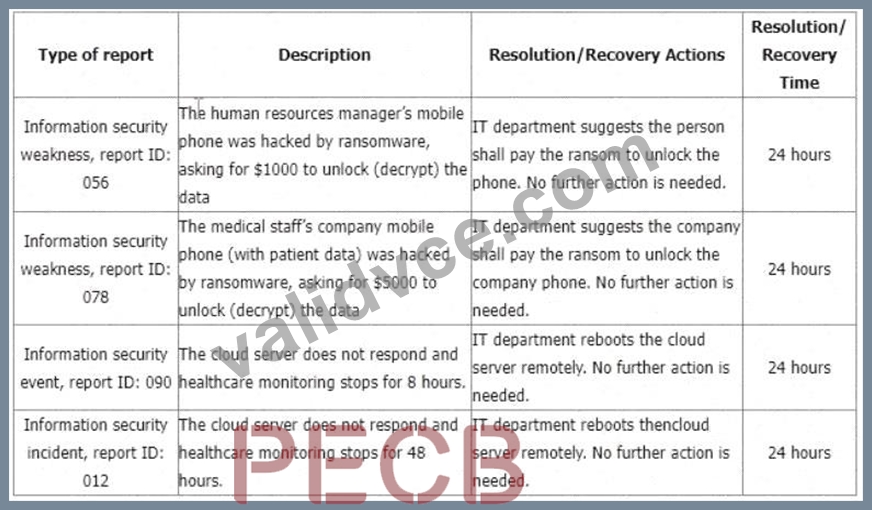
您想進一步調查其他領域以收集更多審計證據。選擇兩個不會出現在您的審核追蹤中的選項。
- A. 收集更多有關組織如何確定事件恢復時間的證據。 (與控制措施 A.5.27 相關)
- B. 透過訪問更多員工了解他們對報告流程的理解來收集更多證據。
(與控制措施 A.6.8 相關) - C. 收集更多有關事件恢復程序的證據。 (與控制措施 A.5.26 相關)
- D. 收集更多證據,說明組織如何確定事件發生後無需採取進一步行動。 (與控制措施 A.5.26 相關)
- E. 收集更多有關人力資源經理如何以及何時支付贖金以解鎖個人行動資料(即信用卡和銀行轉帳)的證據。 (與控制措施 A.5.26 相關)
- F. 收集更多關於公司如何以及何時支付贖金以解鎖公司手機和資料(即信用卡和銀行轉帳)的證據。 (與控制措施 A.5.26 相關)
Answer: E,F
Explanation:
*C. Collect more evidence on how and when the Human Resources manager pays the ransom fee to unlock personal mobile data, i.e., credit card, and bank transfer. (Relevant to control A.5.26) This is not relevant to the audit of the organization's incident management process. The HR manager's personal phone and how they handle a ransomware attack on it falls outside the scope of the ISMS audit. The organization is not responsible for personal devices.
*B. Collect more evidence on how and when the company pays the ransom fee to unlock the company's mobile phone and data, i.e., credit card, and bank transfer. (Relevant to control A.5.26) While seemingly relevant, this focuses on the method of payment for the ransom. The core issue is the organization paying the ransom at all, which is generally not best practice in incident response. The audit should focus on why this decision was made and if alternative solutions were considered (e.g., data backups, device wiping and restoration).
Why the other options ARE relevant:
*A. Collect more evidence by interviewing more staff about their understanding of the reporting process.
(Relevant to control A.6.8) This directly addresses the identified discrepancy in understanding "weakness, event, and incident," which is crucial for proper incident reporting.
*D. Collect more evidence on how the organisation determined the incident recovery time. (Relevant to control A.5.27) This investigates the basis for the 24-hour recovery time, which seems arbitrary and may not be appropriate for all incidents.
*E. Collect more evidence on how the organization determined no further action was needed after the incident. (Relevant to control A.5.26) This probes the adequacy of the incident response, especially the lack of preventative measures after paying the ransom.
*F. Collect more evidence on the incident recovery procedures. (Relevant to control A.5.26) This examines the actual procedures to assess their effectiveness and alignment with best practices.
NEW QUESTION # 110
當應用於 ISO 19011 中所述的內部稽核計畫管理流程時,哪兩項活動與計畫-執行-檢查-行動循環的「檢查」階段一致?
- A. 保留內部審核記錄
- B. 定義每次內部審核的審核標準和範圍
- C. 檢討內部稽核結果的趨勢
- D. 更新內部審核計劃
- E. 建立基於風險的內部稽核計劃
- F. 驗證內部稽核計畫的有效性
- G. 進行內部審核
Answer: C,F
Explanation:
The Check stage of the PDCA cycle involves monitoring and measuring the performance of the process and comparing it with the planned objectives and criteria. In the context of managing an internal audit programme, this stage includes verifying the effectiveness of the internal audit programme by evaluating whether it meets its objectives, scope, and criteria, and whether it is implemented in accordance with ISO 19011 guidelines1. It also includes reviewing the trends in internal audit results by analyzing the data collected from the audits, such as audit findings, nonconformities, corrective actions, opportunities for improvement, and customer feedback1. Reference: ISO 19011:2018 - Guidelines for auditing management systems
NEW QUESTION # 111
情境二:
Clinic成立於1990年代,是一家專注於心臟疾病治療和複雜外科手術的醫療器材公司。公司總部位於歐洲,服務對象包括病患和醫療專業人員。 Clinic收集患者數據,用於制定個人化治療方案、監測治療效果並改善設備功能。為了增強資料安全性並建立信任,Clinic正在實施基於ISO/IEC 27001的資訊安全管理系統(ISMS)。此舉體現了Clinic致力於安全管理敏感患者資訊和專有技術的承諾。
診所僅考慮內部問題、介面、內部活動與外包活動之間的依賴關係以及相關方的期望,來確定其資訊安全管理系統 (ISMS) 的範圍。該範圍已詳細記錄並公開。在定義其 ISMS 時,診所選擇專注於研發、病患資料管理和客戶支援等關鍵部門的關鍵流程。
儘管初期面臨挑戰,診所仍堅持推進資訊安全管理系統(ISMS)的實施,並根據自身獨特需求量身訂做安全控制措施。專案團隊在排除ISO/IEC 27001標準附件A中的某些控制措施的同時,納入了其他產業特定的控制措施以增強安全性。團隊評估了這些控制措施在內部和外部因素下的適用性,最終制定了一份全面的適用性聲明(SoA),詳細闡述了控制措施選擇和實施背後的理由。
隨著認證準備工作的推進,被任命為團隊負責人的布萊恩採用了一種自主風險評估方法,以識別和評估公司的策略問題和安全措施。這種積極主動的方法確保了診所的風險評估與其目標和使命保持一致。
問題:
根據方案二,診所決定資訊安全管理系統(ISMS)僅涵蓋關鍵流程和部門。這種做法是否可以接受?
- A. 是的,但排除其他流程和部門的決定必須有正當理由。
是的,組織可以限制資訊安全管理系統 (ISMS) 的範圍,但如果 ISMS 的範圍未涵蓋所有流程和部門,則不能申請認證審核。 - B. 否,診所必須將所有流程和部門都納入範圍,無論它們對資訊安全管理系統的重要性或相關性如何。
Answer: A
Explanation:
Comprehensive and Detailed In-Depth Explanation:
* A. Correct Answer: ISO/IEC 27001 Clause 4.3 (Determining the Scope of the ISMS) allows organizations to limit the scope, provided that exclusions do not undermine security effectiveness and are justified.
* B. Incorrect: Organizations can request certification even if the ISMS scope is limited, as long as it is justified.
* C. Incorrect: ISO/IEC 27001 does not mandate full inclusion of all departments in the ISMS.
Clinic's decision is acceptable only if the exclusions are justified.
NEW QUESTION # 112
請將以下情況與所需的審核類型相符。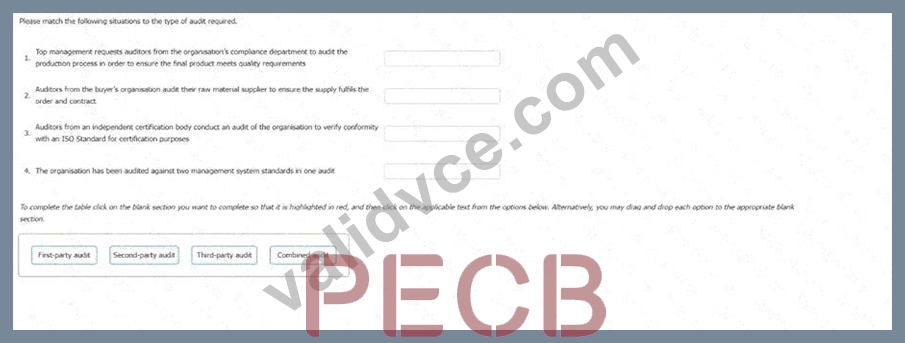
Answer:
Explanation: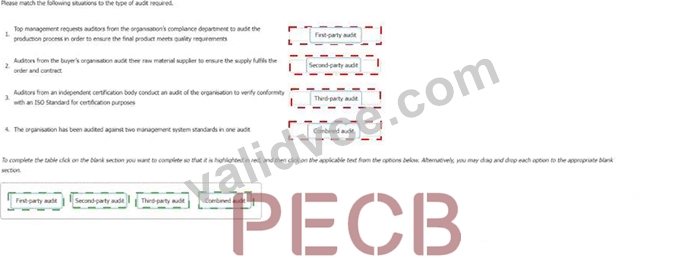
Explanation:
* Top management requests auditors from the organisation's compliance department to audit the production process in order to ensure the final product meets quality requirements = First-party audit
* Auditors from the buyer's organisation audit their raw material supplier to ensure the supply fulfils the order and contract = Second-party audit
* Auditors from an independent certification body conduct an audit of the organisation to verify conformity with an ISO Standard for certification purposes = Third-party audit
* The organisation has been audited against two management system standards in one audit = Combined audit According to the ISO/IEC 27001 standard, there are three main categories of audits: internal, external, and certification1. An internal audit, also known as a first-party audit, is an audit conducted by the organisation itself, or by an external party on its behalf, for management review and other internal purposes12. An external audit, also known as a second-party audit, is an audit conducted by a customer or other interested party on a supplier or contractor to verify compliance with contractual or other requirements12. A certification audit, also known as a third-party audit, is an audit conducted by an independent certification body to verify conformity with an ISO standard for certification purposes12. A combined audit is an audit where two or more management system standards are audited together3.
1: PECB Candidate Handbook - ISO/IEC 27001 Lead Auditor, page 192: ISO 27001 Audit Types and How They are Conducted23: The Four ISO 27001 Audit Categories, Explained4
NEW QUESTION # 113
下列哪一個選項是與人員管理相關的控制措施,旨在避免事件的發生?
- A. 組織定期為員工提供安全意識和培訓課程
- B. 在新部門整合到組織後,組織總是會檢視安全策略
- C. 組織定期進行使用者存取審查,以驗證只有授權員工才能存取機密資訊
Answer: A
Explanation:
Regular security awareness and training sessions for employees are a control measure aimed at preventing security incidents by ensuring that personnel are aware of information security threats and concerns, and understand their roles and responsibilities in safeguarding organizational assets. This proactive approach is designed to educate employees on the importance of security practices and to avoid the occurrence of security incidents. References: = This answer is based on the principles of personnel security management as outlined in ISO/IEC 27001, particularly in Annex A.7 which deals with human resource security before, during, and after employment, and Annex A.9 which focuses on access control and ensuring that employees have access only to the information that is necessary for their job role
NEW QUESTION # 114
下列敘述中哪兩項是正確的?
- A. 在第三方審計期間,審計員會評估組織如何確保其了解法律要求的變更。
- B. 組織只需遵守與其資訊安全管理系統直接相關的法律法規。
- C. 認證機構審核員的角色包括評估組織的流程,以確保其符合法律要求。
- D. 該組織不得將審查立法環境以確保遵守法律法規的任務外包。
- E. 作為認證機構審核的一部分,審核員負責核實組織的合法合規狀態。
- F. 在認證機構審核期間,審核員應確保保留文件訊息,以確定組織必須遵守的法律法規。
Answer: A,F
Explanation:
From Exact Extract:
Explanation for B (True):
This statement is true because ISO 27001 requires an organization to establish processes for identifying, reviewing, and complying with applicable legal, statutory, regulatory, and contractual obligations. A key part of this is being aware of changes to these requirements to maintain ongoing compliance. An auditor's role is to verify that the organization has such a process in place and that it is effective.
Reference:
ISO/IEC 27001:2022, Clause 6.1.3 "Information security risk treatment": While not directly stating "legal requirements," this clause implies that the organization must determine controls to treat information security risks, and compliance with legal requirements is a significant risk factor.
ISO/IEC 27001:2022, Annex A.5.31 "Legal, statutory, regulatory and contractual requirements": This control states: "The organization should identify, document, and comply with relevant legal, statutory, regulatory, and contractual requirements related to information security." This inherently includes processes for staying aware of changes.
ISO/IEC 27002:2022, 5.31 (Guidance for A.5.31): Provides more detail, emphasizing the need for processes to "identify all relevant legal, statutory, regulatory and contractual requirements, and to ensure that appropriate action is taken to comply with these requirements." This explicitly includes monitoring for changes.
ISO/IEC 17021-1:2015, Clause 9.1.2 "Audit objectives": An audit objective is to determine "the ability of the management system to ensure the client meets applicable statutory, regulatory and contractual requirements." This necessarily involves checking the process for identifying changes.
Explanation for E (True):
ISO 27001 mandates the retention of documented information for various aspects of the ISMS, including the identification of legal requirements. Auditors will look for evidence that the organization has indeed identified and documented the applicable legislation it needs to comply with.
Reference:
ISO/IEC 27001:2022, Clause 7.5.1 "General," 7.5.2 "Creating and updating documented information," and
7.5.3 "Control of documented information": These clauses generally require documented information to be maintained and retained as specified by the standard.
ISO/IEC 27001:2022, Annex A.5.31 "Legal, statutory, regulatory and contractual requirements": As mentioned above, this control explicitly states that the organization should "identify, document, and comply with relevant legal, statutory, regulatory and contractual requirements." The term "document" directly implies
"documented information is retained."
ISO/IEC 27002:2022, 5.31 (Guidance for A.5.31): Further elaborates that the identified requirements should be documented and kept up to date.
Explanation for A (False):
The organization is required to comply with all applicable legal, statutory, and regulatory requirements, as well as contractual obligations. Information security often intersects with broader legal frameworks (e.g., data protection, privacy, industry-specific regulations) that may not directly relate to the ISMS in a narrow sense, but are critical to the organization's overall compliance and its information security posture.
Reference:
ISO/IEC 27001:2022, Annex A.5.31 "Legal, statutory, regulatory and contractual requirements": This control does not limit compliance to only what "directly relates" but to "relevant" requirements. The scope of
"relevant" is determined by the organization's context, operations, and information it handles.
Explanation for C (False):
Organizations can and often do outsource tasks like legal environment reviews to specialized legal firms or subscribe to legal compliance services. The ISO 27001 standard does not prohibit outsourcing. However, the organization remains ultimately accountable for ensuring that these outsourced processes meet the requirements of the ISMS and that legal compliance is maintained. The auditor would verify the organization's oversight of such outsourced activities.
Reference:
ISO/IEC 27001:2022, Clause 8.1 "Operational planning and control": This clause states that organizations should "control planned changes and review the consequences of unintended changes, taking action to mitigate any adverse effects" and "ensure that outsourced processes are controlled." This implicitly allows outsourcing but requires control.
Explanation for D (False):
A certification body auditor's role is not to act as a legal compliance officer or to definitively verify the organization's actual legal compliance status (i.e., whether they are perfectly compliant with every law). That responsibility lies with the organization itself, often supported by its legal counsel. The auditor's role is to verify that the organization has established, implemented, and maintains an effective process for identifying, managing, and complying with legal requirements as required by ISO 27001. They audit the management system's approach to compliance, not the legal compliance outcome itself.
Reference:
ISO/IEC 17021-1:2015, Clause 9.1.2 "Audit objectives": States that the audit is to determine "the ability of the management system to ensure the client meets applicable statutory, regulatory and contractual requirements." It does not state the auditor's role is to legally verify compliance.
ISO/IEC 27001:2022, Introduction: Emphasizes that the standard specifies requirements for establishing, implementing, maintaining, and continually improving an ISMS, not for guaranteeing absolute legal compliance outside the scope of the ISMS processes.
Explanation for F (This statement is generally aligned with the role, but less precise as a 'sole true' statement compared to B and E):
While this statement is generally true about the auditor's role, its phrasing "to ensure compliance with their legal requirements" can be misinterpreted. As explained for D, the auditor evaluates the processes designed to achieve compliance, not the absolute legal compliance itself. However, in the context of multiple-choice questions where you pick the "most true" statements, it conveys a similar intent to B, but B and E are more precise regarding specific auditor actions and ISMS requirements. Given B and E are unequivocally true as specific audit actions/requirements, they are the stronger correct answers.
Reference:
ISO/IEC 17021-1:2015, Clause 9.1.2 "Audit objectives": As noted before, the audit objective includes evaluating the management system's ability to meet requirements. This aligns with evaluating processes.
NEW QUESTION # 115
本組織擁有第三方認證機構核發的 ISO/IEC 27001 資訊安全管理系統 (ISMS) 認證。下列哪一項代表了擁有認可認證的優點?
- A. 組織產品的行銷價格上漲
- B. 客戶端數量增加
- C. 審核報告的清晰度
- D. 對認證過程可信度的認可。
Answer: D
Explanation:
One of the advantages of having accredited certification of ISMS to ISO/IEC 27001:2022 is that it demonstrates the recognition of the credibility of the certification process. Accredited certification means that the certification body has been assessed and approved by an accreditation body, which ensures that the certification body operates according to international standards and follows impartiality, competence and consistency principles. Accredited certification also enhances the confidence of the organisation's customers, partners, regulators and other interested parties in the organisation's information security performance and compliance. Reference: = ISO/IEC 27001:2022, clause 0.2; [PECB Candidate Handbook ISO 27001 Lead Auditor], page 6; Key Benefits of ISO 27001 Certification - IT Governance.
NEW QUESTION # 116
您正在一家提供醫療保健服務的住宅療養院進行 ISMS 初始認證審核。審計計劃的下一步是召開末次會議。在最終審核小組會議上,身為審核組組長,您同意報告 2 項輕微不符合項和 1 項改進機會,如下: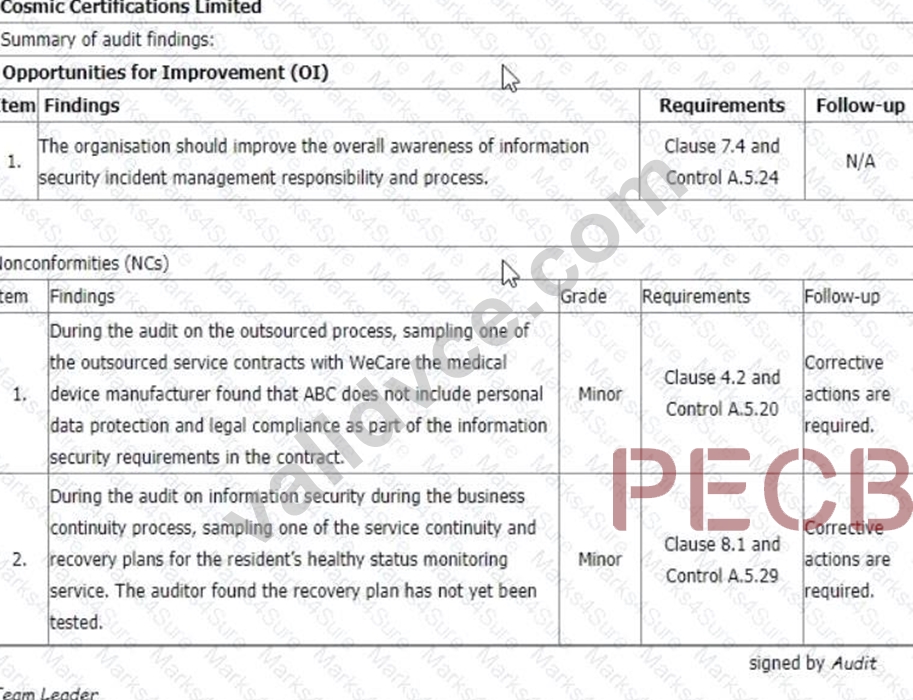
選擇您將在最後一次會議上向受審核方提供建議的審核專案經理的建議選項。
- A. 建議在未來某個日期進行突擊審核
- B. 建議在 3 個月內進行部分審核
- C. 建議在 6 個月內進行全面的重新審核
- D. 立即推薦認證
- E. 在您批准擬議的糾正措施計劃後建議進行認證 建議可以在 1 年內透過監督審核結束調查結果
Answer: E
Explanation:
According to ISO/IEC 17021-1:2015, which specifies the requirements for bodies providing audit and certification of management systems, clause 9.4.9 requires the certification body to make a certification decision based on the information obtained during the audit and any other relevant information1. The certification body should also consider the effectiveness of the corrective actions taken by the auditee to address any nonconformities identified during the audit1. Therefore, when making a recommendation to the audit programme manager, an ISMS auditor should consider the nature and severity of the nonconformities and the proposed corrective actions.
Based on the scenario above, the auditor should recommend certification after their approval of the proposed corrective action plan and recommend that the findings can be closed out at a surveillance audit in 1 year. The auditor should provide the following justification for their recommendation:
* Justification: This recommendation is appropriate because it reflects the fact that the auditee has only two minor nonconformities and one opportunity for improvement, which do not indicate a significant or systemic failure of their ISMS. A minor nonconformity is defined as a failure to achieve one or more requirements of ISO/IEC 27001:2022 or a situation which raises significant doubt about the ability of an ISMS process to achieve its intended output, but does not affect its overall effectiveness or conformity2. An opportunity for improvement is defined as a suggestion for improvement beyond what is required by ISO/IEC 27001:20222. Therefore, these findings do not prevent or preclude certification, as long as they are addressed by appropriate corrective actions within a reasonable time frame. The auditor should approve the proposed corrective action plan before recommending certification, to ensure that it is realistic, achievable, and effective. The auditor should also recommend that the findings can be closed out at a surveillance audit in 1 year, to verify that the corrective actions have been implemented and are working as intended.
The other options are not valid recommendations for the audit programme manager, as they are either too lenient or too strict for the given scenario. For example:
* Recommend certification immediately: This option is not valid because it implies that the auditor ignores or accepts the nonconformities, which is contrary to the audit principles and objectives of ISO
19011:20182, which provides guidelines for auditing management systems. It also contradicts the requirement of ISO/IEC 17021-1:20151, which requires the certification body to consider the effectiveness of the corrective actions taken by the auditee before making a certification decision.
* Recommend that a full scope re-audit is required within 6 months: This option is not valid because it implies that the auditor overreacts or exaggerates the nonconformities, which is contrary to the audit principles and objectives of ISO 19011:20182. It also contradicts the requirement of ISO/IEC 17021-1:
20151, which requires the certification body to determine whether a re-audit is necessary based on the nature and extent of nonconformities and other relevant factors. A full scope re-audit is usually reserved for major nonconformities or multiple minor nonconformities that indicate a serious or widespread failure of an ISMS.
* Recommend that an unannounced audit is carried out at a future date: This option is not valid because it implies that the auditor distrusts or doubts the auditee's commitment or capability to implement corrective actions, which is contrary to the audit principles and objectives of ISO 19011:20182. It also contradicts the requirement of ISO/IEC 17021-1:20151, which requires the certification body to conduct unannounced audits only under certain conditions, such as when there are indications of serious problems with an ISMS or when required by sector-specific schemes.
* Recommend that a partial audit is required within 3 months: This option is not valid because it implies that the auditor imposes or prescribes a specific time frame or scope for verifying corrective actions, which is contrary to the audit principles and objectives of ISO 19011:20182. It also contradicts the requirement of ISO/IEC 17021-1:20151, which requires the certification body to determine whether a partial audit is necessary based on the nature and extent of nonconformities and other relevant factors.
A partial audit may be appropriate for minor nonconformities, but the time frame and scope should be agreed upon with the auditee and based on the proposed corrective action plan.
References: ISO/IEC 17021-1:2015 - Conformity assessment - Requirements for bodies providing audit and certification of management systems - Part 1: Requirements, ISO 19011:2018 - Guidelines for auditing management systems
NEW QUESTION # 117
場景 8:苔絲
一個。 Malik 和 Michael 是一個由安全、合規以及業務規劃和策略領域的獨立且合格的專家組成的審計團隊。他們被指派到一家大型網頁設計公司Clastus進行認證審核。他們在進行審計時表現出了出色的職業道德,包括公正和客觀。這一次,Clastus 確信,如果獲得 ISO/IEC 27001 認證,他們將領先一步。
審計團隊負責人 Tessa 擁有審計專業知識,並且在 IT 相關問題、合規性和治理方面擁有非常成功的背景。馬利克擁有組織規劃和風險管理背景。他的專業知識依賴於對組織的安全控制及其風險承受能力的綜合和分析水平,以準確描述組織內部的風險水平 另一方面,Michael 是通過遵循嚴格的標準化程序進行控制評估的實際安全性的專家。
在執行所需的審計活動後,泰莎發起了一次審計團隊會議,他們分析了邁克爾的一項發現,以客觀、準確地就該問題做出決定。 Michael 遇到的問題是組織日常運作中的一個小問題,他認為這是由組織的一名 IT 技術人員造成的,因此,Tessa 會見了高層管理人員,並在他們詢問了責任人姓名後,告訴他們誰應該對這一問題負責,為了方便澄清和理解,Tessa 在審核的最後一天召開了結束會議。在這次會議上,她向 Clastus 管理層報告了發現的不符合情況。然而,Tessa 收到建議,避免在 Clastus 認證審核的審核報告中提供不必要的證據,確保報告保持簡潔並專注於關鍵發現。
根據審查的證據,審核小組起草了審核結論,並決定在授予認證之前必須對該組織的兩個領域進行審核。這些決定後來被提交給被審計方,但被審計方不接受調查結果並提議提供更多資訊。儘管受審計方提出了意見,但審計員已經決定接受認證建議,因此沒有接受補充資訊。被審計單位的高階主管堅持審計結論並不代表事實,但審計小組仍堅持他們的決定。
根據上述情景,回答以下問題:
根據審計小組的決定,克拉斯特斯下一步該採取什麼行動?
- A. 提交行動計劃
- B. 執行行動計畫的後續行動
- C. 評估矯正措施
Answer: A
Explanation:
Comprehensive and Detailed In-Depth
A . Correct Answer:
ISO/IEC 27001:2022 Clause 10.1 (Improvement) requires organizations to submit action plans to address audit findings.
Clastus must document an action plan before corrective actions can be evaluated or followed up.
B . Incorrect:
Corrective actions can only be evaluated after action plans are submitted and implemented.
C . Incorrect:
Follow-up occurs after corrective actions have been executed and verified.
Relevant Standard Reference:
NEW QUESTION # 118
您會在某些實體資產上看到藍色貼紙。這意味著什麼?
- A. 資產非常關鍵,其故障將影響組織中小組/專案的工作
- B. 資產至關重要,影響力僅限於員工
- C. 帶有藍色貼紙的資產應始終保持空調狀態
- D. 資產非常重要,其故障會影響整個組織
Answer: A
Explanation:
You see a blue color sticker on certain physical assets. This signifies that the asset is high critical and its failure will affect a group/s/project's work in the organization. A blue color sticker is a type of label that indicates the level of criticality of an asset, which is a measure of how important an asset is for the organization's operations and objectives. A high critical asset is an asset that has a significant impact on the organization's activities, and its loss or damage would cause major disruption or loss of service. A blue color sticker also implies that the asset requires a high level of protection and security, and should be handled with care. Reference: : CQI & IRCA ISO 27001:2022 Lead Auditor Course Handbook, page 36. : [ISO/IEC 27001 Brochures | PECB], page 6.
NEW QUESTION # 119
......
Get up-to-date Real Exam Questions for ISO-IEC-27001-Lead-Auditor-CN: https://www.validvce.com/ISO-IEC-27001-Lead-Auditor-CN-exam-collection.html
Pass ISO-IEC-27001-Lead-Auditor-CN Exam Latest Practice Questions: https://drive.google.com/open?id=1xz-IBK_aDWRZmUvlVjBRPWChCsCbQUv3
