

Fire Plan Examiner CFPE Dumps | Updated Nov 08, 2024 - ValidVCE
Master 2024 Latest The Questions Fire Plan Examiner and Pass CFPE Real Exam!
NEW QUESTION # 46
A fire alarm component that only contains indicator lamps, alphanumeric displays, or other equivalent means in which each indication provides status information about a circuit, condition, or location is called
- A. a control panel
- B. a master control unit
- C. a visible textual notification appliance
- D. an annunciator
Answer: D
Explanation:
An annunciator is a fire alarm component that provides visual indicators (such as lamps or alphanumeric displays) to show the status of various circuits, conditions, or locations in a fire alarm system. It helps responders quickly identify the location and nature of the alarm condition without needing to go to the control panel itself.
NEW QUESTION # 47
What is the classification for an area in a building with a permanent multi-level play structure?
- A. Educational
- B. Multipurpose assembly
- C. Class C mercantile
- D. Special amusement
Answer: D
Explanation:
An area with a permanent multi-level play structure is typically classified as "Special amusement" under NFPA 101, Life Safety Code. Special amusement areas are defined as those that contain attractions or activities with significant challenges to egress due to their complexity, such as play structures, mazes, or interactive exhibits. This classification ensures that special safety measures are in place to handle the unique risks associated with such areas.
NEW QUESTION # 48
For the purposes of fire sprinkler protection, occupancies where combustibility is low. quantity of combustibles is moderate, and stockpiles of combustibles do not exceed 8 ft (2.4 m). are called
- A. Light hazard
- B. Extra hazard (Group 1)
- C. Ordinary hazard (Group 2)
- D. Ordinary hazard (Group 1)
Answer: D
Explanation:
Occupancies where the combustibility is low, the quantity of combustibles is moderate, and stockpiles of combustibles do not exceed 8 feet (2.4 meters) are classified as "Ordinary hazard (Group 1)." This classification, as defined in NFPA 13, Standard for the Installation of Sprinkler Systems, is used to determine the design density and spacing of sprinklers required to provide adequate fire protection.
NEW QUESTION # 49
Exhibit.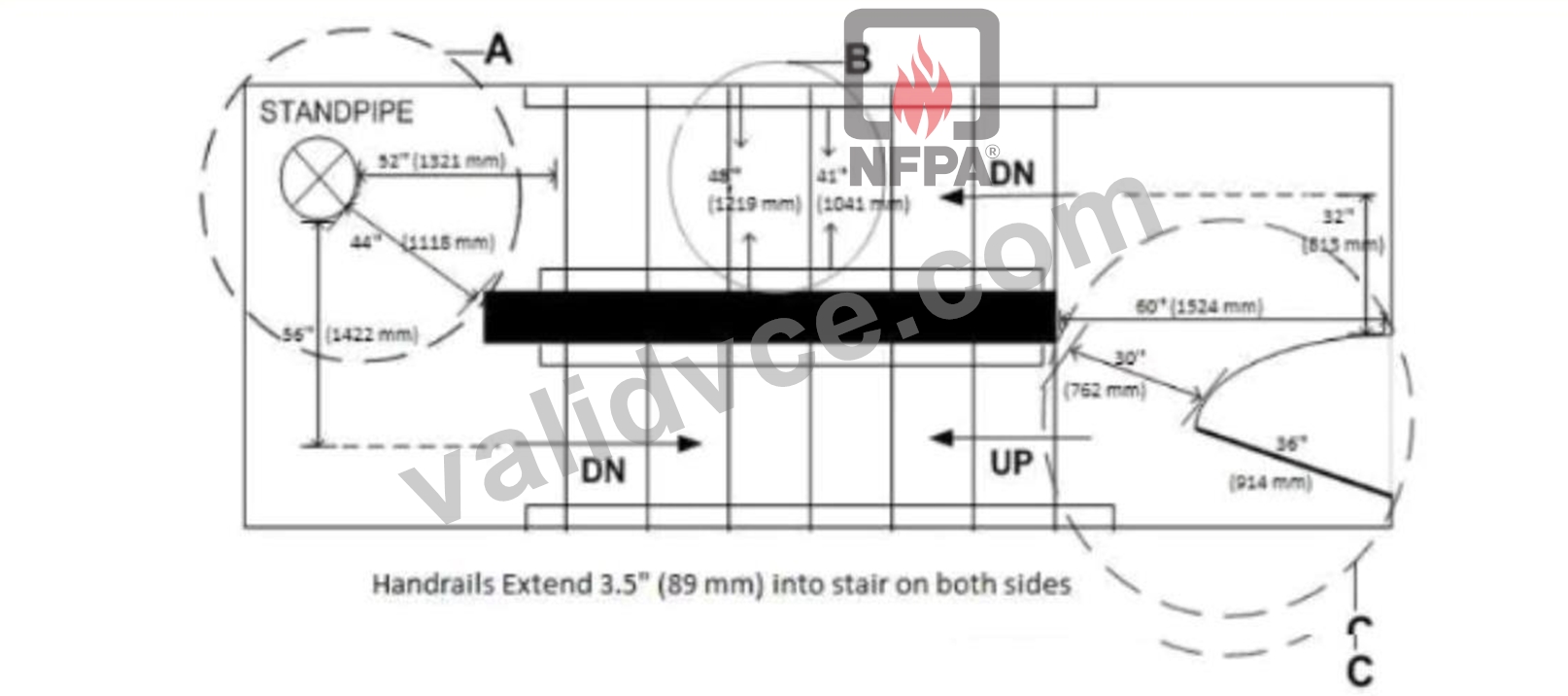
Given the layout shown in the figure, with handrails 38 inches (965 mm) m height what is the available egress width at point B?
- A. 48 in.(1,219 mm)
- B. 41 in. (1,041 mm)
- C. 44 in. (1,118 mm)
- D. 52 in. (1,321 mm)
Answer: B
Explanation:
Based on the figure, point B appears to represent a location where the egress path is narrowed due to handrails or other obstructions. The available egress width at point B is 41 inches (1,041 mm), considering the encroachment of the handrails into the stairwell.
NEW QUESTION # 50
On plan F0.1 the hydraulic calculations for the design were based on which of the following minimum flow criteria''
- A. 740 gpm (2,800 lpm)
- B. 1,040 gpm (3,937 ipm)
- C. 840 gpm (3,180 lpm)
- D. 1,500 gpm (5,6781pm)
Answer: B
Explanation:
On plan F0.1, the hydraulic calculations for the design were based on a minimum flow of 1,040 gpm (3,937 lpm). This flow rate is specified under the "Hydraulic Calculations" section as the baseline criteria used for designing the fire protection system to ensure adequate water supply and pressure during a fire incident.
NEW QUESTION # 51
The material in annex A of NFPA codes and standards is considered
- A. approved
- B. explanatory
- C. recommended
- D. mandatory
Answer: B
Explanation:
Annex A in NFPA codes and standards typically contains explanatory material. This material is provided for informational purposes only and is not considered a mandatory part of the standard. It offers additional guidance, examples, and clarification to help users understand and apply the standard's requirements more effectively.
NEW QUESTION # 52
What is the occupant load for a 3,240 ft2 (301 m2) single story, retail bicycle shop?
- A. 126 people
- B. 108 people
- C. 124 people
- D. 32 people
Answer: B
Explanation:
According to NFPA 101, Life Safety Code, the occupant load for a retail space is calculated by dividing the total floor area by the occupant load factor specified for the occupancy type. For mercantile occupancies (such as a retail bicycle shop), the occupant load factor is typically 30 square feet (2.8 square meters) per person.
Occupant Load = Total Area / Occupant Load Factor = 3,240 ft² / 30 ft² per person = 108 people Therefore, the occupant load for a 3,240 ft² (301 m²) single-story, retail bicycle shop is 108 people.
NEW QUESTION # 53
What is a plat plan?
- A. A survey map of a given geographical area
- B. A civil site plan
- C. An architectural site plan
- D. An overall project layout
Answer: A
Explanation:
A plat plan, or plat map, is a survey map that shows the divisions of a given geographical area. It typically outlines property boundaries, lot dimensions, easements, and rights of way. This type of plan is used primarily for land development, real estate, and legal purposes, providing a detailed view of how land is subdivided.
NEW QUESTION # 54
What is the maximum travel distance to a single means of egress from a shoe store, if the store is not sprinklered and is less than 2.800 ft2 (260 m2) in size?
- A. 100 ft (30 m)
- B. 25 ft (8 m)
- C. 75 ft (23 m)
- D. 50 ft (15 m)
Answer: C
Explanation:
According to NFPA 101, Life Safety Code, the maximum travel distance to a single means of egress from a mercantile occupancy (such as a shoe store) that is not protected by an automatic sprinkler system is 75 feet (23 meters). This requirement is intended to ensure that occupants can evacuate the building safely in the event of an emergency. The distance is measured along the natural path of travel from any point in the store to the nearest exit.
NEW QUESTION # 55
The responsibilities of a Board of Appeals includes which of the following?
I). Interpreting the codes
II). Reviewing alternative methods and procedures
III). Ruling on challenges to the building or fire official regarding the applicability and interpretation of the codes
IV). Evaluating alternative proposals for compliance with the codes
- A. II and III
- B. II, III. and IV
- C. I
- D. I, II, III, and IV
Answer: D
Explanation:
The Board of Appeals typically has several responsibilities, including interpreting the codes (I), reviewing alternative methods and procedures (II), ruling on challenges to the building or fire official regarding the applicability and interpretation of the codes (III), and evaluating alternative proposals for compliance with the codes (IV). These responsibilities ensure that the board provides a fair process for resolving disputes related to code enforcement and allows for alternative solutions that meet the intent of the codes.
NEW QUESTION # 56
What is the occupancy classification of a restaurant, if it has an occupant load greater than 50 people?
- A. Kitchen
- B. Mercantile
- C. Assembly
- D. Business
Answer: C
Explanation:
According to NFPA 101, Life Safety Code, and NFPA 5000, Building Construction and Safety Code, a restaurant with an occupant load greater than 50 people is classified as an "Assembly" occupancy. An Assembly occupancy is defined as an occupancy used for a gathering of 50 or more persons for deliberation, worship, entertainment, eating, drinking, amusement, awaiting transportation, or similar uses. Since the restaurant has an occupant load greater than 50 people, it falls under this category.
For exact details, refer to NFPA 101 (Life Safety Code), Chapter 3, and NFPA 5000 (Building Construction and Safety Code).
NEW QUESTION # 57
How many fire hydrants are located on the project site on plan L2?
- A. Three
- B. Zero
- C. Two
- D. One
Answer: D
Explanation:
NFPA 1031, Standard for Professional Qualifications for Fire Inspector and Plan Examiner, does not provide specific details regarding the number of fire hydrants on a specific project site or plan. NFPA 1031 outlines the qualifications and job performance requirements for professionals, such as Fire Plan Examiners, responsible for reviewing fire protection systems and ensuring code compliance.
For determining the number of fire hydrants on a project site as indicated on plan L2, you will need to reference the specific project documents or site plans, which are not included in the provided files. A Fire Plan Examiner, according to NFPA 1031, would need to review the site plans, including plan L2, to identify the number and locations of fire hydrants. The examiner uses skills and knowledge, as defined in NFPA 1031, to evaluate and ensure the plans meet the required fire protection standards and codes, including ensuring adequate fire hydrant placement for fire safety and emergency access.
If further details or clarification about specific project documents are needed, consulting the actual site plan or reaching out to the relevant authorities, such as the local fire marshal or project manager, would be essential.
NEW QUESTION # 58
Exhibit.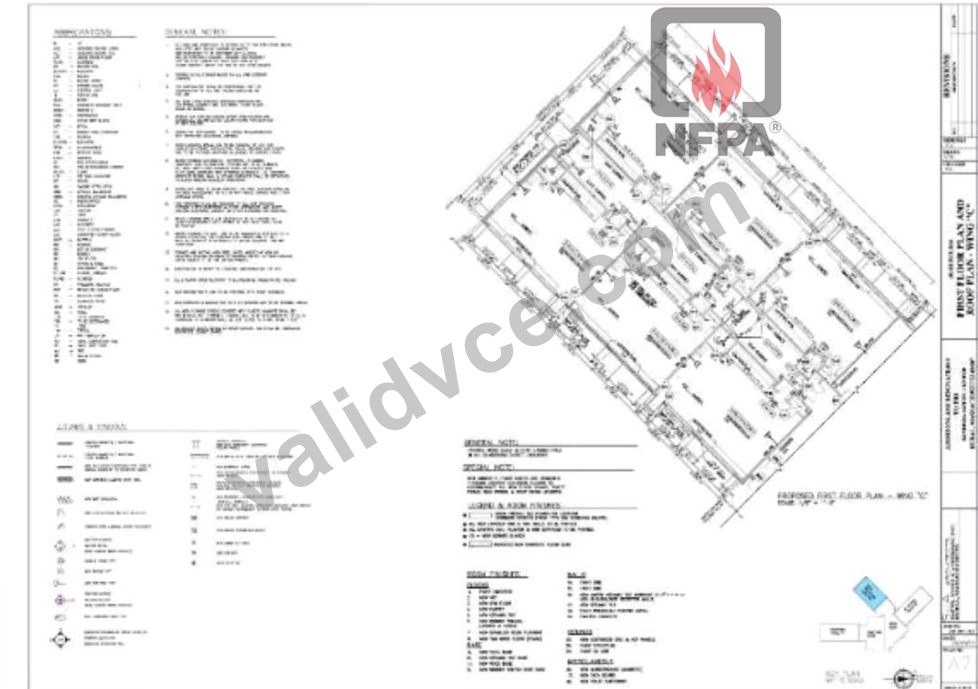
What is the maximum occupant load for Kindergarten classroom 19 on plan A7?
- A. 58 persons
- B. 41 persons
- C. 66 persons
- D. 77 persons
Answer: A
NEW QUESTION # 59
Exhibit.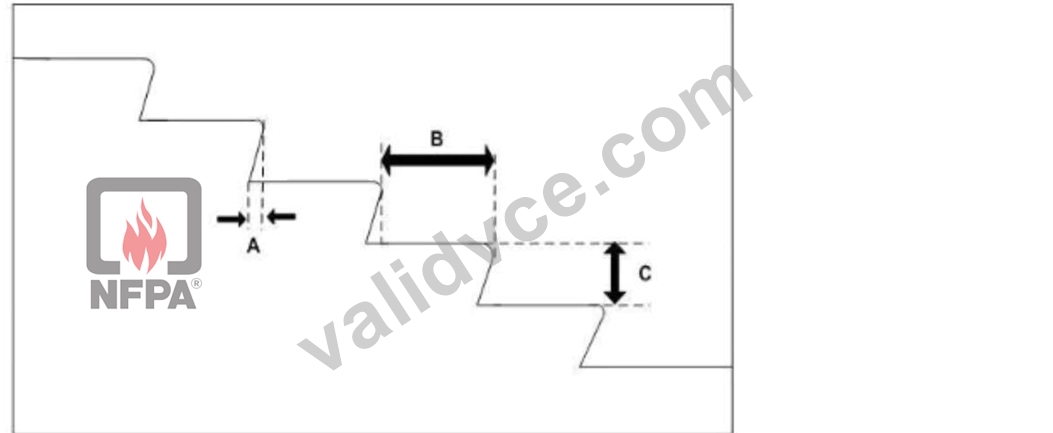
For the included figure, which dimension is the tread depth?
- A. (A)
- B. (A) + (B)
- C. (C)
- D. (B)
Answer: D
Explanation:
The tread depth is the horizontal distance from the front edge of a stair tread to the back edge of the same tread, which corresponds to dimension "B" in the figure. According to NFPA 101, Life Safety Code, the tread depth is crucial in ensuring safe stairway design for proper footing and egress.
NEW QUESTION # 60
Exhibit.
Using scale C, on the water supply graph 3 found on plan F0.2, what is the residual pressure availableflowing at 1 000 gpm (3,785 Lpm)?
- A. 62 psi (4.2 ban
- B. 75 psi (5.1 bar)
- C. 42 psi (2.9 bar>
- D. 15 psi (1 bar)
Answer: C
Explanation:
To determine the residual pressure available at a flow of 1,000 gpm (3,785 Lpm), locate the 1,000 gpm point on the horizontal axis of the water supply graph and trace vertically to intersect the residual pressure curve.
Then, read the corresponding pressure value on the vertical axis. Based on the exhibit provided, the residual pressure available at 1,000 gpm flow is approximately 42 psi (2.9 bar).
NEW QUESTION # 61
NFPA is responsible for which of the following activities involved in the code development process?
I. Establish rules to promote fairness of the process
II. Perform laboratory tests to validate accuracy of published information III Enforce compliance of codes and standards IV. Administer the development process
- A. II and III
- B. II and IV
- C. I and IV
- D. 1 and III
Answer: C
Explanation:
The National Fire Protection Association (NFPA) is responsible for establishing the rules that ensure fairness and transparency in the development process of codes and standards (I) and administering this development process (IV). The NFPA does not perform laboratory tests to validate the accuracy of published information (II), nor does it enforce compliance with the codes and standards (III). Compliance enforcement is the responsibility of local authorities having jurisdiction (AHJ).
NEW QUESTION # 62 
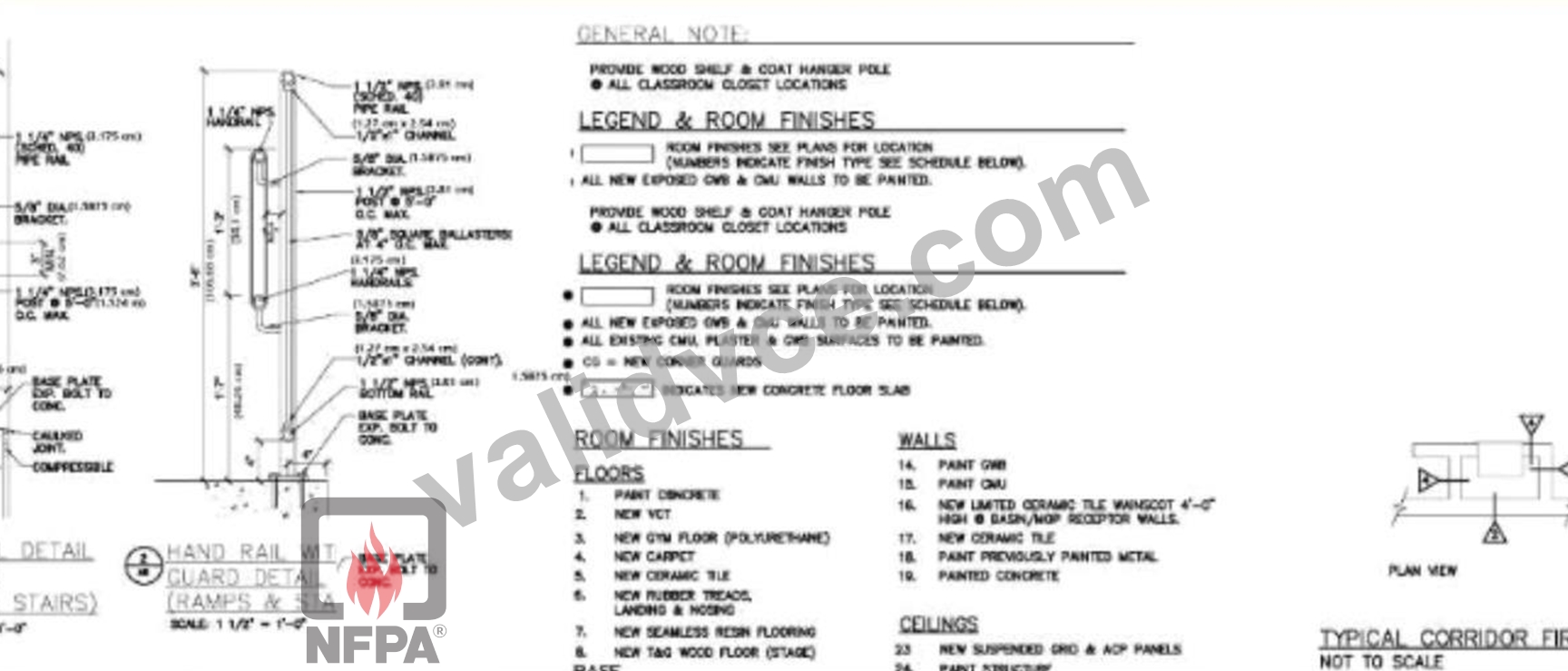
What is the occupant loadof the cafetorium on plan A5 if me room is set up for a less concentrated use without fixed seating'?
- A. 0
- B. 1
- C. 2
- D. 3
Answer: B
Explanation:
The occupant load for a space without fixed seating is typically calculated based on the occupancy type and its use. According to NFPA 101, Life Safety Code, for a room set up for less concentrated use (such as a cafetorium without fixed seating), the occupant load factor is usually 15 square feet per person. If the total area of the cafetorium is approximately 5,910 square feet (394 occupants), then dividing the total area by 15 gives an occupant load of 394 persons.
NEW QUESTION # 63
What is the minimum fire flow duration for a 21.000 ft2 (1.950 m2) building of type II (000) construction?
- A. 4 hours
- B. 2 hours
- C. 1 hour
- D. 3 hours
Answer: D
Explanation:
According to NFPA 1, Fire Code, the minimum fire flow duration for a building of 21,000 square feet (1,950 m²) with Type II (000) construction is 3 hours. This duration is based on the fire flow requirements necessary to maintain sufficient water supply for firefighting operations, ensuring the safety of occupants and property.
NEW QUESTION # 64
What is the permitted fire flow reduction for two buildings on the same lot with a separation of 40 ft (12 m)?
- A. 50 percent
- B. 40 percent
- C. 33 percent
- D. 25 percent
Answer: D
Explanation:
For two buildings on the same lot with a separation of 40 ft (12 m), a fire flow reduction of 25 percent is permitted. This reduction is typically allowed under the guidelines of NFPA standards or local fire codes, which consider the distance between structures and the associated fire risk. A separation of 40 feet is sufficient to warrant a 25 percent reduction in required fire flow, assuming that other fire safety measures, such as sprinkler systems, are in place.
NEW QUESTION # 65
What is the interior finish rating for exits in educational occupancies?
- A. Class A
- B. Class A or B
- C. Class B
- D. Class B or C
Answer: B
Explanation:
According to NFPA 101, Life Safety Code, the interior finish for exits in educational occupancies must be Class A or B.
Class A finishes have the lowest flame spread and smoke development indices, while Class B finishes are also considered safe but slightly less restrictive than Class A. This requirement ensures that exit routes remain safe and clear in the event of a fire, facilitating rapid evacuation.
NEW QUESTION # 66
......
A fully updated 2024 CFPE Exam Dumps exam guide from training expert ValidVCE: https://www.validvce.com/CFPE-exam-collection.html
Practice To CFPE - ValidVCE Remarkable Practice On your Certified Fire Plan Examiner (CFPE)Exam Exam: https://drive.google.com/open?id=19a7jc3_i0E8GxeMAqY-hGGNexQaPJkih
