

Verified NetSec-Analyst dumps Q&As - Pass Guarantee Exam Dumps Test Engine [2026]
NetSec-Analyst dumps and 373 unique questions
NEW QUESTION # 57
An internal host wants to connect to servers of the internet through using source NAT.
Which policy is required to enable source NAT on the firewall?
- A. NAT policy with source zone and destination zone specified
- B. post-NAT policy with external source and any destination address
- C. NAT policy with no source of destination zone selected
- D. pre-NAT policy with external source and any destination address
Answer: A
NEW QUESTION # 58
A large manufacturing facility is deploying thousands of new IoT sensors for predictive maintenance. These sensors communicate over MQTT and generate sensitive operational data'. The security team needs to implement a robust IoT security profile on their Palo Alto Networks Next-Generation Firewall (NGFW) to ensure data confidentiality, integrity, and device authentication. Which of the following approaches is MOST effective for establishing a strong IoT security posture for these sensors, assuming they cannot support complex PKI or client certificates initially?
- A. Use GlobalProtect VPN to secure each individual sensor's connection to the corporate network, requiring pre-shared keys for authentication.
- B. Create a new 'IoT Security Profile' object, enable 'Device Identification' for MQTT, configure a custom 'IoT Policy Rule' to permit MQTT traffic based on device attributes identified by the NGFW, and utilize 'Device Group' segmentation.
- C. Rely solely on network segmentation (VLANs) to isolate IoT devices, with no specific application or device-aware security policies.
- D. Deploy a dedicated IoT gateway for all sensor traffic, configure static NAT for each sensor, and apply a standard 'Antivirus' and 'Anti-Spyware' profile to the gateway's outbound traffic.
- E. Implement a custom URL filtering profile to block all non-MQTT traffic and apply a default Security Policy for all IoT zones.
Answer: B
Explanation:
Option B is the most effective. Palo Alto Networks NGFWs can identify IoT devices and their attributes, including application (MQTT), even without client certificates. By creating a specific IoT Security Profile and leveraging 'Device Identification' and 'Device Group' segmentation, the NGFW can enforce granular policies based on the type of IoT device, its behavior, and the applications it uses, far beyond basic port-based filtering. This allows for a 'least privilege' approach crucial for IoT security. Option A is too simplistic and lacks device-awareness. Option C introduces an additional point of failure and doesn't leverage the NGFW's IoT capabilities. Option D is impractical for thousands of resource- constrained sensors. Option E provides isolation but no deep packet inspection or behavior analysis.
NEW QUESTION # 59
Which Security profile would you apply to identify infected hosts on the protected network using DNS traffic?
- A. anti-spyware
- B. antivirus
- C. URL traffic
- D. vulnerability protection
Answer: A
NEW QUESTION # 60
An administrator has configured a Security policy where the matching condition includes a single application and the action is deny If the application s default deny action is reset-both what action does the firewall take*?
- A. It sends a TCP reset to the client-side and server-side devices
- B. It sends a TCP reset to the server-side device
- C. It silently drops the traffic and sends an ICMP unreachable code
- D. It silently drops the traffic
Answer: A
NEW QUESTION # 61
Which plane on a Palo alto networks firewall provides configuration logging and reporting functions on a separate processor?
- A. security processing
- B. management
- C. data
- D. network processing
Answer: B
NEW QUESTION # 62
Which type of administrative role must you assign to a firewall administrator account, if the account must include a custom set of firewall permissions?
- A. Role-based
- B. Dynamic
- C. Multi-Factor Authentication
- D. SAML
Answer: A
NEW QUESTION # 63
A large enterprise is migrating a critical application to a new microservices architecture, resulting in highly dynamic network traffic patterns within a segmented data center. The security team is struggling to define precise security policies due to the ephemeral nature of microservice IPs and ports. They want to leverage Palo Alto Networks features to automatically learn and recommend policies based on observed traffic, and then continually monitor for policy deviations. Which sequence of actions and tools would be most effective?
- A. 1. Implement Security Policy Rules with 'any' for application and service. 2. Use Command Center to identify the most active microservices. 3. Manually narrow down 'any' rules based on Command Center data.
- B. 1. Enable Learning Mode on relevant security rules. 2. Use Activity Insights to observe new application patterns. 3. Manually create new rules based on observed traffic and commit.
- C. 1. Deploy GlobaIProtect for all microservices. 2. Use Activity Insights to track user-based microservice access. 3. Rely on Threat Prevention profiles to secure communication.
- D. 1. Configure Dynamic Address Groups (DAGs) with integration to orchestration platforms. 2. Enable App-ID for all inter-microservice traffic. 3. Leverage Policy Optimizer's 'Policy Recommendation' feature based on observed traffic. 4. Continuously monitor with Command Center for deviations from learned baselines.
- E. 1. Use Activity Insights to generate reports on all inter-VPC traffic. 2. Manually define security policies using IP addresses and port ranges. 3. Monitor for policy hits and misses using firewall logs.
Answer: D
Explanation:
This scenario demands dynamic policy enforcement. Dynamic Address Groups (DAGs) are crucial for handling ephemeral IPs by integrating with cloud/orchestration platforms. App-ID is fundamental for identifying actual applications, not just ports, which is vital for microservices. Policy Optimizer's 'Policy Recommendation' (often tied to App-ID and User-ID learning) directly addresses the need to 'automatically learn and recommend policies based on observed traffic.' Finally, Command Center provides the real-time visibility to 'continually monitor for policy deviations' from the established baselines.
NEW QUESTION # 64
What two authentication methods on the Palo Alto Networks firewalls support authentication and authorization for role-based access control? (Choose two.)
- A. SAML
- B. Kerberos
- C. LDAP
- D. TACACS+
Answer: A,D
Explanation:
Reference: https://docs.paloaltonetworks.com/pan-os/9-1/pan-os-admin/firewall-administration/manage- firewall-administrators/administrative-authentication.html The administrative accounts are defined on an external SAML, TACACS+, or RADIUS server. The server performs both authentication and authorization. For authorization, you define Vendor-Specific Attributes (VSAs) on the TACACS+ or RADIUS server, or SAML attributes on the SAML server. PAN-OS maps the attributes to administrator roles, access domains, user groups, and virtual systems that you define on the firewall.
NEW QUESTION # 65
A global financial institution utilizes Strata Cloud Manager (SCM) to manage thousands of Palo Alto Networks firewalls. Due to strict regulatory compliance requirements (e.g., PCI DSS, GDPR), they need to ensure that all policy changes are peer-reviewed and logged with detailed audit trails. Furthermore, they want to automate the rollback of any erroneous policy deployments. Which SCM features, combined with external processes, would best achieve these objectives?
- A. Cloud-Delivered Security Services (CDSS) and threat prevention signatures.
- B. Zero Touch Provisioning (ZTP) and Application-ID.
- C. Device telemetry forwarding and advanced threat intelligence feeds.
- D. Granular RBAC, Audit Logs, Configuration Revision History, and API-driven rollback capabilities.
- E. Integrated SD-WAN orchestration and Prisma Access integration.
Answer: D
Explanation:
This scenario requires robust change management and auditing. Granular RBAC ensures that only authorized personnel can make changes, and that changes are initiated by specific roles. SCM's Audit Logs provide an immutable record of all administrative actions and policy changes. The Configuration Revision History allows viewing and reverting to previous configurations. For automated rollback, SCM's API (Application Programming Interface) can be used to programmatically trigger rollbacks of configurations, integrating with external change management or orchestration systems. This combination addresses the compliance and automation requirements.
NEW QUESTION # 66
How does the Policy Optimizer policy view differ from the Security policy view?
- A. It specifies applications seen by rules.
- B. It provides sorting options that do not affect rule order.
- C. It displays rule utilization.
- D. It details associated zones.
Answer: B
Explanation:
You can't filter or sort rules in PoliciesSecurity because that would change the order of the policy rules in the rulebase. Filtering and sorting PoliciesSecurityPolicy OptimizerNo App Specified, PoliciesSecurityPolicy OptimizerUnused Apps, and PoliciesSecurityPolicy OptimizerNew App Viewer (if you have a SaaS Inline Security subscription) does not change the order of the rules in the rulebase. https://docs.paloaltonetworks.com
/pan-os/11-0/pan-os-admin/app-id/security-policy-rule-optimization/policy-optimizer-concepts/sorting-and- filtering-security-policy-rules
NEW QUESTION # 67
Which link in the web interface enables a security administrator to view the security policy rules that match new application signatures?
- A. Review App Matches
- B. Review Policies
- C. Pre-analyze
- D. Review Apps
Answer: B
NEW QUESTION # 68
How many zones can an interface be assigned with a Palo Alto Networks firewall?
- A. three
- B. four
- C. two
- D. one
Answer: D
NEW QUESTION # 69
Which setting is available to edit when a tag is created on the local firewall?
- A. Location
- B. Color
- C. Priority
- D. Order
Answer: B
Explanation:
https://docs.paloaltonetworks.com/pan-os/9-1/pan-os-web-interface-help/objects/objects-tags/create-tags
NEW QUESTION # 70
Which administrator type utilizes predefined roles for a local administrator account?
- A. Role-based
- B. Device administrator
- C. Superuser
- D. Dynamic
Answer: D
NEW QUESTION # 71
Which action related to App-ID updates will enable a security administrator to view the existing security policy rule that matches new application signatures?
- A. Review App Matches
- B. Review Policies
- C. Pre-analyze
- D. Review Apps
Answer: B
Explanation:
Reference:
https://docs.paloaltonetworks.com/pan-os/9-0/pan-os-admin/app-id/manage-new-app-ids-introduced- incontent-releases/review-new-app-id-impact-on- existing-policy-rules
NEW QUESTION # 72
A Security Administrator is configuring a Palo Alto Networks firewall to block access to known malicious IP addresses. The threat intelligence feed updates hourly and contains thousands of entries. Which External Dynamic List (EDL) type is most appropriate for this scenario to ensure the firewall efficiently processes and applies the updates?
- A. URL
- B. IP Address (IPv4/lPv6)
- C. Domain
- D. Pre-defined EDL (e.g., Palo Alto Networks' Threat Prevention feeds)
- E. Custom Application
Answer: B
Explanation:
For blocking known malicious IP addresses, an 'IP Address (IPv4/lPv6)' EDL is the most direct and efficient type. While Palo Alto Networks' pre-defined feeds are also IP-based and often used, the question specifically asks for the most appropriate type when the administrator is configuring a feed with thousands of entries, implying a custom or third-party feed. Domain and URL lists are for FQDNs and URLs, respectively, not raw IP addresses. Custom Application is irrelevant here.
NEW QUESTION # 73
What can be achieved by disabling the Share Unused Address and Service Objects with Devices setting on Panorama?
- A. Increase the backup capacity for configuration backups per firewall
- B. Reduce the configuration and session synchronization time between HA pairs
- C. Increase the per-firewall capacity for address and service objects
- D. Reduce the number of objects pushed to a firewall
Answer: D
NEW QUESTION # 74
Which administrator type utilizes predefined roles for a local administrator account?
- A. Role-based
- B. Device administrator
- C. Superuser
- D. Dynamic
Answer: D
Explanation:
References:
NEW QUESTION # 75
Where within the URL Filtering security profile must a user configure the action to prevent credential submissions?
- A. URL Filtering > Categories
- B. URL Filtering > URL Filtering Settings
- C. URL Filtering > HTTP Header Insertion
- D. URL Filtering > Inline Categorization
Answer: A
Explanation:
URL filtering technology protects users from web-based threats by providing granular control over user access and interaction with content on the Internet. You can develop a URL filtering policy that limits access to sites based on URL categories, users, and groups. For example, you can block access to sites known to host malware and prevent end users from entering corporate credentials to sites in certain categories.
NEW QUESTION # 76
What must be considered with regards to content updates deployed from Panorama?
- A. Panorama can only install up to five content versions of the same type for potential rollback scenarios.
- B. Content update schedulers need to be configured separately per device group.
- C. A PAN-OS upgrade resets all scheduler configurations for content updates.
- D. Panorama can only download one content update at a time for content updates of the same type.
Answer: D
NEW QUESTION # 77
All users from the internal zone must be allowed only Telnet access to a server in the DMZ zone. Complete the two empty fields in the Security Policy rules that permits only this type of access.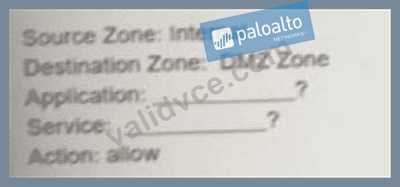
Choose two.
- A. Application = "any"
- B. Service = "any"
- C. Application = "Telnet"
- D. Service - "application-default"
Answer: C,D
NEW QUESTION # 78
......
NetSec-Analyst Dumps for Pass Guaranteed - Pass NetSec-Analyst Exam: https://www.validvce.com/NetSec-Analyst-exam-collection.html
NetSec-Analyst Exam Dumps - Try Best NetSec-Analyst Exam Questions: https://drive.google.com/open?id=1QqYCOvENwCXyZlYY6rRcJLQ2RkjqnoH0
