

Updated Jul-2022 Test Engine to Practice MCIA-Level-1 Test Questions
MCIA-Level-1 Real Exam Questions Test Engine Dumps Training With 132 Questions
MuleSoft mcia - Level 1: MuleSoft Certified Integration Architect - Level 1 Exam Certified Professional salary
The average salary of a MuleSoft mcia - Level 1: MuleSoft Certified Integration Architect - Level 1 Exam Certified Expert in:
- England - 75,000 POUND
- United State - 100,200 USD
- India. - 14,00,327 INR
- Europe - 70,500 EURO
NEW QUESTION 28
A Mule application uses an HTTP Request operation to invoke an external API.
The external API follows the HTTP specification for proper status code usage.
What is a possible cause when a 3xx status code is returned to the HTTP Request operation from the external API?
- A. The request was REDIRECTED to a different URL by the external API
- B. The request was NOT RECEIVED by the external API
- C. The request was NOT ACCEPTED by the external API
- D. The request was ACCEPTED by the external API
Answer: A
Explanation:
Explanation/Reference: https://www.w3.org/Protocols/rfc2616/rfc2616-sec10.html
NEW QUESTION 29
What Anypoint Connectors support transactions?
- A. Database, VM, File
- B. Database, JMS, VM
- C. Database, JMS, VM, SFTP
- D. Database, JMS, HTTP
Answer: B
Explanation:
Explanation/Reference: https://docs.mulesoft.com/mule-runtime/4.2/transaction-management
NEW QUESTION 30
A Mule application is running on a customer-hosted Mule runtime in an organization's network. The Mule application acts as a producer of asynchronous Mule events. Each Mule event must be broadcast to all interested external consumers outside the Mule application. The Mule events should be published in a way that is guaranteed in normal situations and also minimizes duplicate delivery in less frequent failure scenarios.
The organizational firewall is configured to only allow outbound traffic on ports 80 and 443. Some external event consumers are within the organizational network, while others are located outside the firewall.
What Anypoint Platform service is most idiomatic (used for its intended purpose) for publishing these Mule events to all external consumers while addressing the desired reliability goals?
- A. Anypoint MQ
- B. CloudHub Shared Load Balancer
- C. Anypoint Exchange
- D. CloudHub VM queues
Answer: A
Explanation:
Set the Anypoint MQ connector operation to publish or consume messages, or to accept (ACK) or not accept (NACK) a message.
NEW QUESTION 31
An external REST client periodically sends an array of records in a single POST request to a Mule application API endpoint.
The Mule application must validate each record of the request against a JSON schema before sending it to a downstream system in the same order that it was received in the array Record processing will take place inside a router or scope that calls a child flow. The child flow has its own error handling defined. Any validation or communication failures should not prevent further processing of the remaining records.
To best address these requirements what is the most idiomatic(used for it intended purpose) router or scope to used in the parent flow, and what type of error handler should be used in the child flow?
- A. For Each scope in the parent flow
On Error Continue error handler in the child flow - B. Until Successful router in the parent flow
On Error Propagate error handler in the child flow - C. First Successful router in the parent flow
On Error Continue error handler in the child flow - D. Parallel For Each scope in the parent flow
On Error Propagate error handler in the child flow
Answer: C
NEW QUESTION 32
What is not true about Mule Domain Project?
- A. Expose multiple services within the Mule domain on the same port
- B. Only available Anypoint Runtime Fabric
- C. This allows Mule applications to share resources
- D. Send events (messages) to other Mule applications using VM queues
Answer: B
Explanation:
* Mule Domain Project is ONLY available for customer-hosted Mule runtimes, but not for Anypoint Runtime Fabric
* Mule domain project is available for Hybrid and Private Cloud (PCE). Rest all provide application isolation and can't support domain project.
What is Mule Domain Project?
* A Mule Domain Project is implemented to configure the resources that are shared among different projects. These resources can be used by all the projects associated with this domain. Mule applications can be associated with only one domain, but a domain can be associated with multiple projects. Shared resources allow multiple development teams to work in parallel using the same set of reusable connectors. Defining these connectors as shared resources at the domain level allows the team to: - Expose multiple services within the domain through the same port. - Share the connection to persistent storage. - Share services between apps through a well-defined interface. - Ensure consistency between apps upon any changes because the configuration is only set in one place.
* Use domains Project to share the same host and port among multiple projects. You can declare the http connector within a domain project and associate the domain project with other projects. Doing this also allows to control thread settings, keystore configurations, time outs for all the requests made within multiple applications. You may think that one can also achieve this by duplicating the http connector configuration across all the applications. But, doing this may pose a nightmare if you have to make a change and redeploy all the applications.
* If you use connector configuration in the domain and let all the applications use the new domain instead of a default domain, you will maintain only one copy of the http connector configuration. Any changes will require only the domain to the redeployed instead of all the applications.
You can start using domains in only three steps:
1) Create a Mule Domain project
2) Create the global connector configurations which needs to be shared across the applications inside the Mule Domain project
3) Modify the value of domain in mule-deploy.properties file of the applications
NEW QUESTION 33
Refer to the exhibit.
An organization uses a 2-node Mute runtime cluster to host one stateless API implementation. The API is accessed over HTTPS through a load balancer that uses round-robin for load distribution.
Two additional nodes have been added to the cluster and the load balancer has been configured to recognize the new nodes with no other change to the load balancer.
What average performance change is guaranteed to happen, assuming all cluster nodes are fully operational?
- A. 50% reduction in the response time of the API
- B. 50% reduction In the JVM heap memory consumed by each node
- C. 100% increase in the throughput of the API
- D. 50% reduction In the number of requests being received by each node
Answer: D
NEW QUESTION 34
An organization is sizing an Anypoint VPC to extend their internal network to Cloudhub.
For this sizing calculation, the organization assumes 150 Mule applications will be deployed among three(3) production environments and will use Cloudhub's default zero-downtime feature. Each Mule application is expected to be configured with two(2) Cloudhub workers.This is expected to result in several Mule application deployments per hour.
- A. 10.0.0.0/24(256 IPs)
- B. 10.0.0.0/22(1024IPs)
- C. 10.0.0.0/23(512 IPs)
- D. 10.0.0.0/21(2048 IPs)
Answer: D
Explanation:
* When you create an Anypoint VPC, the range of IP addresses for the network must be specified in the form of a Classless Inter-Domain Routing (CIDR) block, using CIDR notation.
* This address space is reserved for Mule workers, so it cannot overlap with any address space used in your data center if you want to peer it with your VPC.
* To calculate the proper sizing for your Anypoint VPC, you first need to understand that the number of dedicated IP addresses is not the same as the number of workers you have deployed.
* For each worker deployed to CloudHub, the following IP assignation takes place: For better fault tolerance, the VPC subnet may be divided into up to four Availability Zones.
* A few IP addresses are reserved for infrastructure. At least two IP addresses per worker to perform at zero-downtime.
* Hence in this scenario 2048 IP's are required to support the requirement.
NEW QUESTION 35
Refer to the exhibit.
This Mule application is deployed to multiple Cloudhub workers with persistent queue enabled. The retrievefile flow event source reads a CSV file from a remote SFTP server and then publishes each record in the CSV file to a VM queue. The processCustomerRecords flow's VM Listner receives messages from the same VM queue and then processes each message separately.
How are messages routed to the cloudhub workers as messages are received by the VM Listener?
- A. Each message is routed to ONE of the Cloudhub workers in a DETERMINSTIC round robin fashion thereby EXACTLY BALANCING messages among the cloudhub workers
- B. Each message is routed to the SAME Cloudhub worker that retrieved the file, thereby BINDING ALL messages to ONLY that ONE Cloudhub worker
- C. Each messages routes to ONE of the available Clouhub workers in a NON- DETERMINSTIC non round-robin fashion thereby APPROXIMATELY BALANCING messages among the cloudhub workers
- D. Each message is duplicated to ALL of the Cloudhub workers, thereby SHARING EACH message with ALL the Cloudhub workers.
Answer: C
NEW QUESTION 36
Refer to the exhibit.
A business process involves the receipt of a file from an external vendor over SFTP. The file needs to be parsed and its content processed, validated, and ultimately persisted to a database. The delivery mechanism is expected to change in the future as more vendors send similar files using other mechanisms such as file transfer or HTTP POST.
What is the most effective way to design for these requirements in order to minimize the impact of future change?
- A. Create a Process API to receive the file and process it using a MuleSoft Batch Job while delegating the data save process to a System API
- B. Use a composite data source so files can be retrieved from various sources and delivered to a MuleSoft Batch Job for processing
- C. Use a MuleSoft Scatter-Gather and a MuleSoft Batch Job to handle the different files coming from different sources
- D. Create an API that receives the file and invokes a Process API with the data contained In the file, then have the Process API process the data using a MuleSoft Batch Job and other System APIs as needed
Answer: D
Explanation:
* Scatter-Gather is used for parallel processing, to improve performance. In this scenario, input files are coming from different vendors so mostly at different times. Goal here is to minimize the impact of future change. So scatter Gather is not the correct choice.
* If we use 1 API to receive all files from different Vendors, any new vendor addition will need changes to that 1 API to accommodate new requirements. So Option A and C are also ruled out.
* Correct answer is Create an API that receives the file and invokes a Process API with the data contained in the file, then have the Process API process the data using a MuleSoft Batch Job and other System APIs as needed. Answer to this question lies in the API led connectivity approach.
* API-led connectivity is a methodical way to connect data to applications through a series of reusable and purposeful modern APIs that are each developed to play a specific role - unlock data from systems, compose data into processes, or deliver an experience. System API : System API tier, which provides consistent, managed, and secure access to backend systems. Process APIs : Process APIs take core assets and combines them with some business logic to create a higher level of value. Experience APIs : These are designed specifically for consumption by a specific end-user app or device.
So in case of any future plans , organization can only add experience API on addition of new Vendors, which reuse the already existing process API. It will keep impact minimal.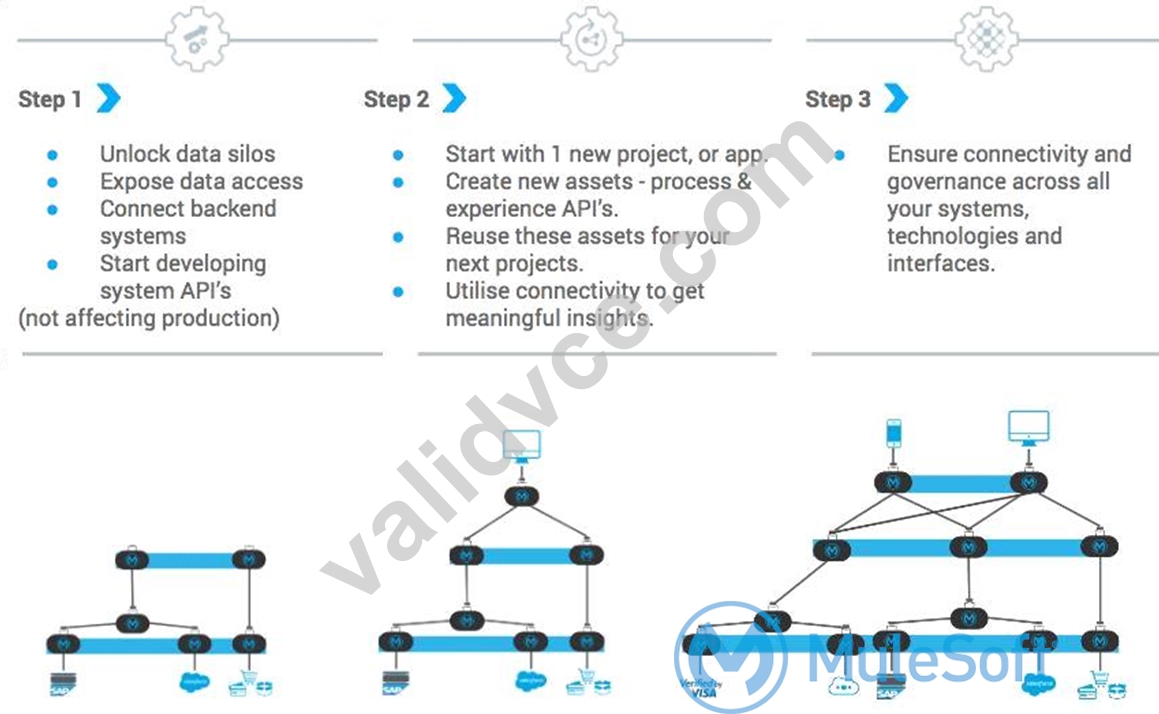
NEW QUESTION 37
Refer to the exhibit.
A Mule application has an HTTP Listener that accepts HTTP DELETE requests. This Mule application Is deployed to three CloudHub workers under the control of the CloudHub Shared Load Balancer.
A web client makes a sequence of requests to the Mule application's public URL.
How is this sequence of web client requests distributed among the HTTP Listeners running in the three CloudHub workers?
- A. Each request is routed to ONE ARBiTRARY CloudHub worker in the PRIMARY Availability Zone (AZ)
- B. Each request Is routed to ONE ARBiTRARY CloudHub worker out of ALL three CloudHub workers
- C. Each request is routed to the PRIMARY CloudHub worker in the PRIMARY Availability Zone (AZ)
- D. Each request is routed (scattered) to ALL three CloudHub workers at the same time
Answer: B
Explanation:
Correct behavior is Each request is routed to ONE ARBITRARY CloudHub worker out of ALL three CloudHub workers
NEW QUESTION 38
An Organization has previously provisioned its own AWS VPC hosting various servers. The organization now needs to use Cloudhub to host a Mule application that will implement a REST API once deployed to Cloudhub, this Mule application must be able to communicate securely with the customer-provisioned AWS VPC resources within the same region, without being interceptable on the public internet.
What Anypoint Platform features should be used to meet these network communication requirements between Cloudhub and the existing customer-provisioned AWS VPC?
- A. Use VM queues in the Mule application to allow any non-mule assets within the customer provisioned AWS VPC to subscribed to and receive messages
- B. Add a default API Whitelisting policy to API Manager to automatically whitelist the customer provisioned AWS VPC IP ranges needed by the Mule applicaton
- C. Add a Mulesoft hosted Anypoint VPC configured and with VPC Peering to the AWS VPC
- D. Configure an external identity provider (IDP) in Anypoint Platform with certificates from the customer provisioned AWS VPC
Answer: B
NEW QUESTION 39
What Mule application can have API policies applied by Anypoint Platform to the endpoint exposed by that Mule application?
- A. A Mule application that accepts gRPC requests over HTTP/2
- B. A Mule application that accepts requests over HTTP/1x
- C. A Mule application that accepts JSON requests over WebSocket
- D. A Mule application that accepts JSON requests over TCP but is NOT required to provide a response.
Answer: B
Explanation:
* HTTP/1.1 keeps all requests and responses in plain text format.
* HTTP/2 uses the binary framing layer to encapsulate all messages in binary format, while still maintaining HTTP semantics, such as verbs, methods, and headers. It came into use in 2015, and offers several methods to decrease latency, especially when dealing with mobile platforms and server-intensive graphics and videos
* Currently, Mule application can have API policies only for Mule application that accepts requests over HTTP/1x
NEW QUESTION 40
An organization has deployed both Mule and non-Mule API implementations to integrate its customer and order management systems. All the APIs are available to REST clients on the public internet.
The organization wants to monitor these APIs by running health checks: for example, to determine if an API can properly accept and process requests. The organization does not have subscriptions to any external monitoring tools and also does not want to extend its IT footprint.
What Anypoint Platform feature provides the most idiomatic (used for its intended purpose) way to monitor the availability of both the Mule and the non-Mule API implementations?
- A. API Functional Monitoring
- B. API Manager
- C. Runtime Manager
- D. Anypoint Visualizer
Answer: D
NEW QUESTION 41
Refer to the exhibit.
A Mule application is deployed to a cluster of two customer-hosted Mute runtimes. The Mute application has a flow that polls a database and another flow with an HTTP Listener.
HTTP clients send HTTP requests directly to individual cluster nodes.
What happens to database polling and HTTP request handling in the time after the primary (master) node of the cluster has railed, but before that node is restarted?
- A. Database polling stops All HTTP requests are rejected
- B. Database polling stops All HTTP requests continue to be accepted
- C. Database polling continues Only HTTP requests sent to the remaining node continue to be accepted
- D. Database polling continues All HTTP requests continue to be accepted, but requests to the failed node Incur increased latency
Answer: C
Explanation:
Correct answer is Database polling continues Only HTTP requests sent to the remaining node continue to be accepted. : Architecture descripted in the question could be described as follows.When node 1 is down , DB polling will still continue via node 2 . Also requests which are coming directly to node 2 will also be accepted and processed in BAU fashion. Only thing that wont work is when requests are sent to Node 1 HTTP connector. The flaw with this architecture is HTTP clients are sending HTTP requests directly to individual cluster nodes. By default, clustering Mule runtime engines ensures high system availability. If a Mule runtime engine node becomes unavailable due to failure or planned downtime, another node in the cluster can assume the workload and continue to process existing events and messages
NEW QUESTION 42
An organization will deploy Mule applications to Cloudhub, Business requirements mandate that all application logs be stored ONLY in an external splunk consolidated logging service and NOT in Cloudhub.
In order to most easily store Mule application logs ONLY in Splunk, how must Mule application logging be configured in Runtime Manager, and where should the log4j2 splunk appender be defined?
- A. Disable Cloudhub logging in Runtime Manager
Define the splunk appender in ONE global log4j.xml file that is uploaded once to Runtime Manger to support at Mule application deployments. - B. Keep thedefault logging configuration in Runtime Manager
Define the Splunk appender in EACH Mule application log4j2.xml file - C. Disable Cloudhub logging in Runtime Manager
Define the splunk appender in EACH Mule application's log4j2.xml file - D. Keep the default logging configuration in RuntimeManager
Define the splunk appender in ONE global log4j.xml file that is uploaded once to Runtime Manager to support at Mule application deployments.
Answer: C
NEW QUESTION 43
Refer to the exhibit. A Mule 4 application has a parent flow that breaks up a JSON array payload into 200 separate items, then sends each item one at a time inside an Async scope to a VM queue.
A second flow to process orders has a VM Listener on the same VM queue. The rest of this flow processes each received item by writing the item to a database.
This Mule application is deployed to four CloudHub workers with persistent queues enabled.
What message processing guarantees are provided by the VM queue and the CloudHub workers, and how are VM messages routed among the CloudHub workers for each invocation of the parent flow under normal operating conditions where all the CloudHub workers remain online?
- A. ALL item VM messages are processed AT MOST ONCE by ONE ARBITRARY CloudHub worker This one CloudHub worker processes ALL 200 item VM messages
- B. EACH item VM message is processed AT LEAST ONCE by ONE ARBITRARY CloudHub worker Each of the four CloudHub workers can be expected to process some item VM messages
- C. EACH item VM message is processed AT MOST ONCE by ONE CloudHub worker, with workers chosen in a deterministic round-robin fashion Each of the four CloudHub workers can be expected to process 1/4 of the item VM messages (about 50 items)
- D. ALL item VM messages are processed AT LEAST ONCE by the SAME CloudHub worker where the parent flow was invoked This one CloudHub worker processes ALL 200 item VM messages
Answer: D
NEW QUESTION 44
A Mule application is being designed To receive nightly a CSV file containing millions of records from an external vendor over SFTP, The records from the file need to be validated, transformed. And then written to a database. Records can be inserted into the database in any order.
In this use case, what combination of Mule components provides the most effective and performant way to write these records to the database?
- A. Use a Parallel for Each scope to Insert records one by one into the database
- B. Use a DataWeave map operation and an Async scope to insert records one by one into the database.
- C. Use a Scatter-Gather to bulk insert records into the database
- D. Use a Batch job scope to bulk insert records into the database.
Answer: D
Explanation:
Correct answer is Use a Batch job scope to bulk insert records into the database
* Batch Job is most efficient way to manage millions of records.
A few points to note here are as follows :
Reliability: If you want reliabilty while processing the records, i.e should the processing survive a runtime crash or other unhappy scenarios, and when restarted process all the remaining records, if yes then go for batch as it uses persistent queues.
Error Handling: In Parallel for each an error in a particular route will stop processing the remaining records in that route and in such case you'd need to handle it using on error continue, batch process does not stop during such error instead you can have a step for failures and have a dedicated handling in it.
Memory footprint: Since question said that there are millions of records to process, parallel for each will aggregate all the processed records at the end and can possibly cause Out Of Memory.
Batch job instead provides a BatchResult in the on complete phase where you can get the count of failures and success. For huge file processing if order is not a concern definitely go ahead with Batch Job
NEW QUESTION 45
A mule application uses an HTTP request operation to involve an external API.
The external API follows the HTTP specification for proper status code usage.
What is possible cause when a 3xx status code is returned to the HTTP Request operation from the external API?
- A. The request was NOT RECEIVED by the external API
- B. The request was not accepted by the external API
- C. The request was Redirected to a different URL by the external API
- D. The request was ACCEPTED by the external API
Answer: C
Explanation:
3xx HTTP status codes indicate a redirection that the user agent (a web browser or a crawler) needs to take further action when trying to access a particular resource.
NEW QUESTION 46
Refer to the exhibit.

A business process involves two APIs that interact with each other asynchronously over HTTP. Each API is implemented as a Mule application. API 1 receives the initial HTTP request and invokes API 2 (in a fire and forget fashion) while API 2, upon completion of the processing, calls back into API l to notify about completion of the asynchronous process.
Each API Is deployed to multiple redundant Mule runtimes and a separate load balancer, and is deployed to a separate network zone.
In the network architecture, how must the firewall rules be configured to enable the above Interaction between API 1 and API 2?
- A. To allow communication between the load balancers used by each API
- B. To enable communication from each API's Mule runtimes and network zone to the toad balancer of the other API
- C. To open direct two-way communication between the Mule runtimes of both APIs
- D. To authorize the certificates used by both the apis
Answer: A
NEW QUESTION 47
An integration Mute application consumes and processes a list of rows from a CSV file. Each row must be read from the CSV file, validated, and the row data sent to a JMS queue, in the exact order as in the CSV file.
If any processing step for a row falls, then a log entry must be written for that row, but processing of other rows must not be affected.
What combination of Mute components is most idiomatic (used according to their intended purpose) when Implementing the above requirements?
- A. For Each scope On Error Continue scope
- B. Async scope On Error Propagate scope
- C. VM connector first Successful scope On Error Propagate scope
- D. Scatter-Gather component On Error Continue scope
Answer: A
Explanation:
* On Error Propagate halts execution and sends error to the client. In this scenario it's mentioned that "processing of other rows must not be affected" so Option B and C are ruled out.
* Scatter gather is used to club multiple responses together before processing. In this scenario, we need sequential processing. So option A is out of choice.
* Correct answer is For Each scope & On Error Continue scope Below requirement can be fulfilled in the below way
1) Using For Each scope , which will send each row from csv file sequentially. each row needs to be sent sequentially as requirement is to send the message in exactly the same way as it is mentioned in the csv file
2) Also other part of requirement is if any processing step for a row fails then it should log an error but should not affect other record processing . This can be achieved using On error Continue scope on these set of activities. so that error will not halt the processing. Also logger needs to be added in error handling section so that it can be logged.
* Attaching diagram for reference. Here it's try scope, but similar would be the case with For Each loop.
NEW QUESTION 48
......
MCIA-Level-1 Actual Questions Answers PDF 100% Cover Real Exam Questions: https://www.validvce.com/MCIA-Level-1-exam-collection.html
